Ni/Au-Coated Carbon Fibers Slash Overpotential in Ammonia Alkaline Electrolysis
Thermally de-sized carbon fibers with electrodeposited Ni/Au layers cut overpotential to 168 mV at 10 mA/cm² in ammonia-containing alkaline electrolytes, offering a substrate-engineering path to cost-effective hydrogen production from ammonia streams.
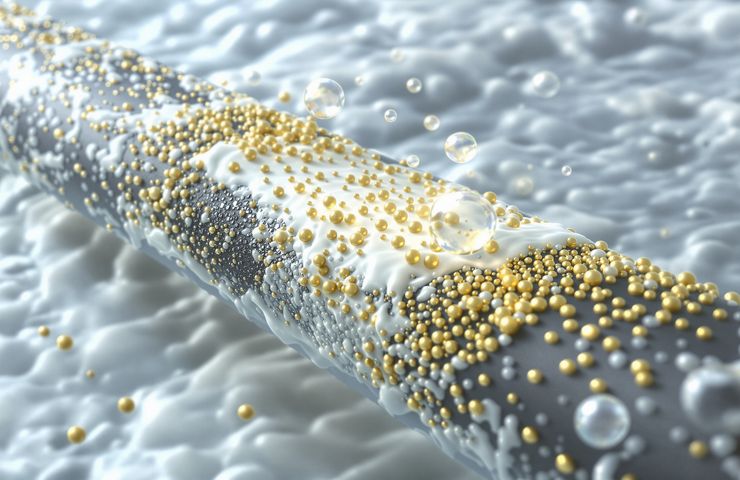
A research group recently published findings in Scientific Reports, revealing that thermally treated carbon fibers supporting layers of nickel and gold can dramatically enhance the hydrogen evolution reaction (HER) in ammonia-laden alkaline electrolytes. This innovative approach not only lowers overpotential but also reduces charge-transfer resistance, effectively transforming a pollution source into a viable fuel feedstock.
Quick Take
Instead of just using carbon fibers as passive structures, the team made them active by stripping away surface sizing to expose the graphitized areas. They then applied about 40 nm of nickel nanoparticles, topped with a thin layer of gold. This combination created intricate Ni/Au interfaces that boasted high surface roughness and robust metal–carbon bonding. In a solution of 1 M KOH + 0.5 M NH3, the electrode managed to hit 10 mA cm⁻² with just a 168 mV overpotential, while also showing a Tafel slope of 57 mV dec⁻¹ and a charge-transfer resistance around 651 Ω. Notably, adding ammonia pushed the current density up by 14–15%. In essence, this means that with carefully designed carbon–metal interfaces, we could see a leap in green hydrogen production methods, especially when working with ammonia-heavy streams.
Under the Hood
The process kicks off with commercially available PAN-based carbon fibers, which undergo thermal de-sizing to remove epoxy coatings and uncover graphitic carbon. Raman spectroscopy showed changes in the D/G band ratio, while XRD analysis revealed sharper (002) peaks—indicators of improved graphitization and precise defect management. These tweaks resulted in uniform nucleation spots for nickel electrodeposition from a NiSO4–H3BO3 bath, forming a sleek coating of around 40 nm of nickel particles on the fiber's grooves and edges. Then, a subsequent gold layer from HAuCl4 and KCl created unique flake- and prism-like crystallites that settle on the nickel layer rather than mixing with it, indicated by minor shifts in XRD peaks suggesting lattice strain at the Ni/Au boundary.
Through electrochemical impedance spectroscopy, it became clear that the Ni/Au interface on treated fibers took charge-transfer resistance down to around 651 Ω, a stark contrast to the much higher values seen on untreated supports. Cyclic voltammetry tests in ferri/ferrocyanide probes showed increased current response and quicker electron transfer, highlighting how the carbon backbone plays a crucial role in moving electrons around. When put under alkaline HER conditions with 0.5 M ammonia, the electrode followed a Volmer–Heyrovsky mechanism, with gold helping to stabilize intermediate hydrogen adsorption and nickel driving the water dissociation process. The result? An overpotential of just 168 mV at 10 mA cm⁻², making ammonia-based hydrogen production a more practical option.
Market Angle
Cutting down on reliance on platinum group metals is key for making hydrogen production more cost-effective. By using carbon fibers as active substrates and limiting gold to a thin overlayer, this setup drastically reduces the need for precious metals. Plus, being able to process ammonia-laden alkaline streams means we can link hydrogen production with wastewater treatment—in other words, businesses can turn ammonia waste into high-purity hydrogen without needing separate scrubbing processes. This dual benefit could be a game changer for municipal utilities and industrial players eager to decarbonize and comply with stricter discharge regulations while tapping into clean hydrogen markets. As the hydrogen infrastructure grows, we might see integrated ammonia electrolysis units positioned right alongside hydrogen storage tanks and refueling stations, serving both fuel cell technology and green data centers in need of backup power. Plus, the modular design of these carbon fiber mats allows for retrofitting in existing alkaline electrolyzers, paving a simple upgrade path for OEMs. Companies could roll out small-scale stacks using Ni/Au-coated fibers to trial real-world durability, and strong performance metrics could help seal clean hydrogen offtake agreements by boosting project-level yields.
In Context
While much of the research focused on green hydrogen production revolves around pure electrolytes, recent developments are honing in on ammonia electrolysis as a CO2-free strategy for generating H2. For instance, a 100 W-class dual-layer Pt–Ir electrode has achieved impressive conversion rates at higher temperatures, and Ru/CNT catalysts have shown solid ammonia-to-hydrogen yields on carbon nanotubes. That said, such systems usually require specialized thermal or membrane setups. Substrate-centric strategies, like this Ni/Au-coated carbon fiber platform, strike a nice balance between performance and complexity. They leverage scalable materials and electrodeposition techniques to create effective interfaces without needing high-temperature reactors. Past research on Pt, Ru, Rh, and Ni cathodes has shown varying HER responses to ammonia, with Rh unexpectedly pulling ahead. Carbon fiber substrates have also outperformed Raney nickel as anodes for ammonia oxidation at low concentrations when coated with Pt–Ir. By meticulously engineering the metal dispersion and charge-transfer kinetics on carbon fibers in ammonia-rich environments, this method offers new insights into broader hydrogen production techniques that seamlessly integrate pollutant treatment with fuel generation.
Policy Watch
As clean ammonia continues to rise in popularity as a hydrogen carrier, regulators are updating their frameworks to keep pace. Emission trading schemes and low-carbon fuel standards are now acknowledging ammonia electrolysis as a valid route for earning clean hydrogen credits, provided the ammonia comes from renewable nitrogen fixation. In the U.S., recent legislation is incentivizing projects that demonstrate combined ammonia removal and hydrogen generation. Meanwhile, Europe’s Fit for 55 package and Japan’s national hydrogen strategy are incorporating ammonia-to-hydrogen conversion in their discharge regulation updates. Safety standards for handling and storing ammonia are also being revised to support these combined electrolysis-electrode systems. If this substrate-engineering approach proves durable over thousands of hours, it could fast-track the permitting process for hydrogen infrastructure, streamline approvals for ammonia refueling stations, and shape offtake agreements by enabling predictable, low-overpotential operations in complex waste streams.
Final Thought
This isn’t merely about tweaking catalysts; it’s really a push to redefine electrodes as multifunctional players in hydrogen production. Carbon fibers, once seen as mere supports, are stepping into the spotlight for interface engineering. As the discourse around hydrogen energy picks up speed, expect manufacturers of alkaline systems to explore substrate-centric designs and challenge the existing reliance on platinum. The big question is: will the industry keep pace with these exciting insights as quickly as researchers can publish them?