Hydrogen Production Advances: KIER’s NiO-NiCo Electrode Lowers Voltage in Alkaline Electrolysis
KIER developed a NiO-NiCo heterostructure cathode for alkaline water electrolysis, cutting voltage to 2.014 V at 1 A/cm² and demonstrating robust durability in single-cell tests.
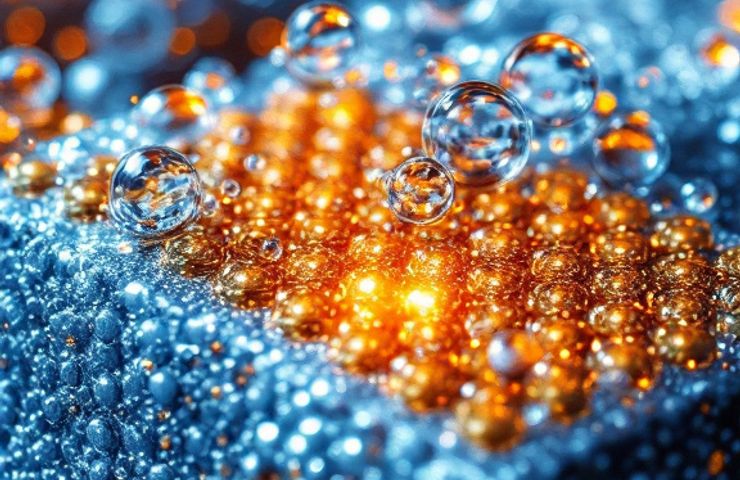
Researchers at the Korea Institute of Energy Research (KIER) have developed a nickel-oxide/nickel-cobalt (NiO-NiCo) heterostructure cathode that reduces the cell voltage in alkaline water electrolysis, according to a peer-reviewed paper in Advanced Science. The finding comes from experiments that move beyond simple material screening. Instead, the team engineered an interface between an oxide and an alloy to target the slow chemistry at the cathode.
Working from KIER’s Hydrogen Energy Institute in Daejeon, the team led by Kyoung-Soo Kang and Hyunjoon Lee collaborated with Korea University, Seoul National University, the Institute for Basic Science and the Tech University of Korea. The project was supported by grants from the Ministry of Science and ICT’s National Research Foundation and by the Institute for Basic Science. Those funders, and the network of institutions, enabled scale-up of both characterization and single-cell testing.
In a zero-gap single-cell test with 59.4 cm² active area, 25 wt.% KOH at 80 °C and 1 A cm−2 current density, the NiO-NiCo electrode achieved 2.014 V, compared with 2.276 V for a bare nickel-foam cathode. The difference—262 mV at operational current density—was consistent with lower overpotentials observed in half-cell screening. In those half-cell tests the electrode delivered an overpotential of 22.7 mV at 10 mA cm−2 and 130.9 mV at 100 mA cm−2. Durability checks showed the electrode maintained performance over 100 hours of operation and after dynamic on-off cycling, with only a 13 mV increase in cell voltage post-test.
Technical Deep Dive
The NiO-NiCo architecture addresses the Volmer step in alkaline hydrogen evolution. NiO, the oxide phase, preferentially interacts with hydroxide and activates water dissociation. The NiCo alloy supplies conductive metallic sites that bind hydrogen intermediates. Where oxide meets metal, electronic modulation occurs. That modulation lowers activation barriers and enables faster kinetics than either NiO-only or NiCo-only electrodes.
Fabrication begins with hydrothermal growth of nickel hydroxide on a nickel-foam substrate, followed by calcination at 400 °C to convert it to NiO. Because NiO is insulating, electrodeposition of NiCo is then applied selectively on conductive regions. The result is adjacent heterointerfaces formed without precious metals. Electron microscopy and X-ray spectroscopy confirm well-defined domains and complementary electronic structures across the interface.
Performance Validation
In controlled half-cell experiments in 1 M KOH at room temperature, the NiO-NiCo electrode reached an overpotential of 22.7 mV at 10 mA cm−2 and 130.9 mV at 100 mA cm−2. Tafel analysis revealed a lower slope for the heterostructure, indicating accelerated kinetics. Electrochemical impedance spectroscopy showed a smaller semicircle in Nyquist plots for NiO-NiCo, confirming lower charge-transfer resistance. During 600 dynamic on-off cycles, the electrode exhibited negligible change in overpotential, suggesting resilience to intermittent power input.
Energy Efficiency Impact
Lowering the cell voltage from 2.276 V to 2.014 V at 1 A cm−2 directly reduces electricity consumption. According to the International Energy Agency, electricity is the largest cost component in alkaline electrolysis. Voltage savings of a few hundred millivolts can translate into meaningful reductions in the levelized cost of hydrogen, provided system-level and balance-of-plant costs are managed in parallel. In short: less voltage at the same current means less energy input for the same hydrogen output.
Strategic Implications
By avoiding platinum-group metals, the NiO-NiCo design aims to cut electrode-material cost—a research communication reports a 99% reduction versus noble catalysts—while leveraging mature nickel-foam substrates. That cost angle is critical for alkaline electrolyzers, where material costs combine with operational expenses. Still, cobalt raises questions. Cobalt supply, environmental impacts and potential leaching require further assessment. And total hydrogen cost also hinges on stack design, diaphragms, water treatment and financing.
Path to Scale
The researchers plan to expand electrode size to 40 cm diameter and target active areas above 5,000 cm² for megawatt-scale tests. Scaling introduces practical hurdles: forming uniform heterointerfaces across larger areas, ensuring coating reproducibility, and proving long-duration durability under fluctuating power. Optimizing manufacturing throughput and material utilization will be key for commercial deployment. The team sees these as engineering challenges rather than fundamental barriers.
Policy Context
This work aligns with South Korea’s hydrogen strategy to strengthen domestic technology and supply chains. Public funding from the Ministry of Science and ICT and the Institute for Basic Science supports the drive toward green hydrogen independence. While no commercial procurement policy has been issued for NiO-NiCo electrodes, such advances could shape future standards for low-cost alkaline electrolyzers. Policy choices on procurement and standards will influence whether lab gains move into production lines.
Alkaline electrolysis has evolved since the late nineteenth century, with Raney nickel surfacing in mid-twentieth-century systems. Engineered heterostructures like NiO-NiCo illustrate a new chapter, targeting kinetic bottlenecks without precious metals. The next test will be translating lab-scale voltage gains into full-stack efficiency and durability over operational lifetimes, a critical step for sustainable hydrogen production. Demonstrating that a lab electrode keeps its voltage advantage in megawatt stacks will determine whether this material approach is practical at commercial scale.