Revolutionizing Hydrogen Storage: A Path Towards Sustainable Energy
Recent innovations in hydrogen storage focus on anchoring ruthenium nanoparticles in nanostructured supports, aiming to enhance the efficiency and stability of hydrogen production for sustainable energy solutions.

In recent developments, a new approach to hydrogen storage — using ruthenium nanoparticles anchored in nanostructured supports — has appeared as a significant development in the field of renewable energy. Researchers and observers frame the technique as a response to persistent technical obstacles around storing hydrogen safely and efficiently. The method focuses on altering how catalysts and supports interact at the nanoscale to influence both production and storage pathways.
The Need for Improved Hydrogen Storage Solutions
Hydrogen is widely regarded as a clean energy carrier, but storing and transporting it remains technically demanding. Current physical storage methods, such as high-pressure cylinders or cryogenic tanks, can require large energy inputs and strict safety regimes. Those constraints raise both operational costs and logistical complexity. As demand for green hydrogen grows, new storage techniques are becoming imperative for the wider hydrogen infrastructure. Policymakers, engineers and supply-chain planners often cite storage constraints as a critical barrier to deployment. Addressing them is therefore central to any realistic roadmap for scaling hydrogen use.
Ruthenium Nanoparticles: A Promising Development
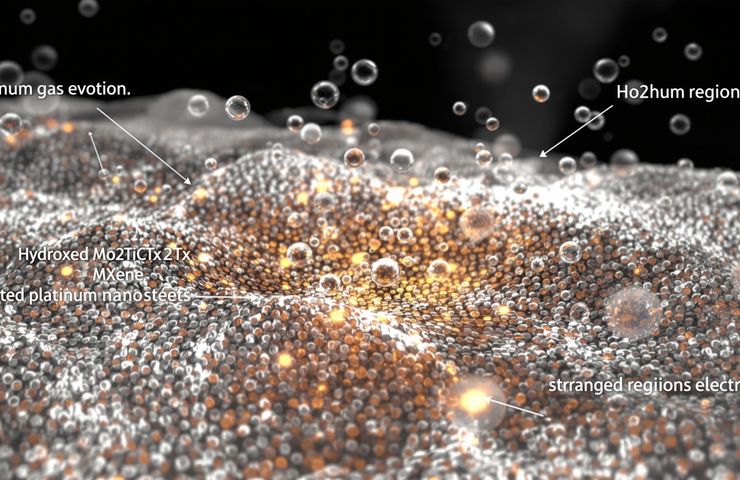
claims made by researchers at iAmbiente posit that anchoring ruthenium nanoparticles—described metaphorically as having "microscopic roots"—could lead to a more efficient and stable hydrogen storage system. The proposal centers on fixing tiny ruthenium particles to high-surface-area supports, such as carbon nanotubes or graphene, so the particles remain dispersed rather than forming larger aggregates.
Anchoring aims to reduce aggregation while increasing the active surface area available for the electrochemical processes involved in hydrogen production and storage. That, in turn, could improve catalyst durability and maintain activity over longer operational periods. In other words: keep the particles separate and reactive, and you may retain catalyst performance under repeated cycling. The concept is straightforward; the engineering challenge is not.
Quantifiable Impact on Hydrogen Production
Research literature indicates that anchoring ruthenium can yield measurable benefits in electrochemical stability and hydrogen production rates. Experimental reports and reviews in the field point to improved activity and longevity when metal nanoparticles are immobilized on compatible supports. For instance, when ruthenium is utilized within specific conditions, studies suggest enhancements in efficiency, thereby supporting the transition to green hydrogen production methods.
Another mechanism cited in the literature is known as hydrogen spillover — a process where hydrogen atoms migrate from a metal surface onto the support material. This transfer can alter how hydrogen is stored or accessed at the interface between the metal and its support. In practice, that could change utilization patterns for stored hydrogen and influence reaction kinetics in devices that both produce and consume hydrogen. At the same time, the exact parameters and implications of this phenomenon need thorough investigation before design rules can be set for commercial systems.
Collaborative Efforts: Bridging Theory and Practical Application
Leading research initiatives are essential to validate these findings and ensure the technology's scalability. Laboratory demonstrations provide early indications, but they do not automatically guarantee performance under industrial conditions. Successful translation will demand coordinated work across universities, national labs and companies that build and operate hydrogen equipment.
Partnerships between academia and industry are often highlighted in discussions about commercialization. Joint efforts would allow researchers to test anchored ruthenium systems under realistic operating profiles and to compile the operational data that manufacturers and regulators require. Importantly, the challenge remains in bridging laboratory successes into commercial viability. Future work must focus on addressing practical concerns regarding storage capacity, cost-effectiveness, safety, and scalability.
Operational testing should gather data on the temperature and pressure conditions under which the anchored ruthenium performs best. Such metrics include cycle stability, rates of deactivation, the degree of particle migration or sintering over time, and how the support interacts chemically with hydrogen under varying conditions. Those data points will inform engineering trade-offs and lifecycle assessments, and they will be necessary inputs for any realistic cost analysis.
A Glimpse into a Sustainable Future
Optimizing hydrogen storage with this novel technique offers a possible pathway toward more practical hydrogen systems. The approach could complement other storage methods, not necessarily replace them. By combining improvements in catalyst stability and support design, anchored ruthenium may help make electrochemical hydrogen production and storage more predictable and more durable.
That said, expectations should remain measured. The pursuit of robust solutions for hydrogen storage is one part of a larger transition to sustainable energy. Progress will depend on a sequence of incremental advances, each validated by careful testing and independent replication. By fostering collaborations in research and pooling expertise across sectors, stakeholders increase the odds that laboratory innovations can mature into deployable technologies.
In conclusion, the ongoing work into anchored ruthenium nanoparticles represents a focused scientific effort within the broader narrative of clean hydrogen technologies. The claims and early literature point to promising directions, but the path to widespread adoption will require systematic validation, rigorous data collection, and clear demonstrations of safety, capacity and cost-effectiveness. If those pieces come together, the technique could become part of the toolkit for integrating hydrogen into global energy systems.