Green Hydrogen Production Pilot Launched at KMG Engineering’s Atyrau Facility
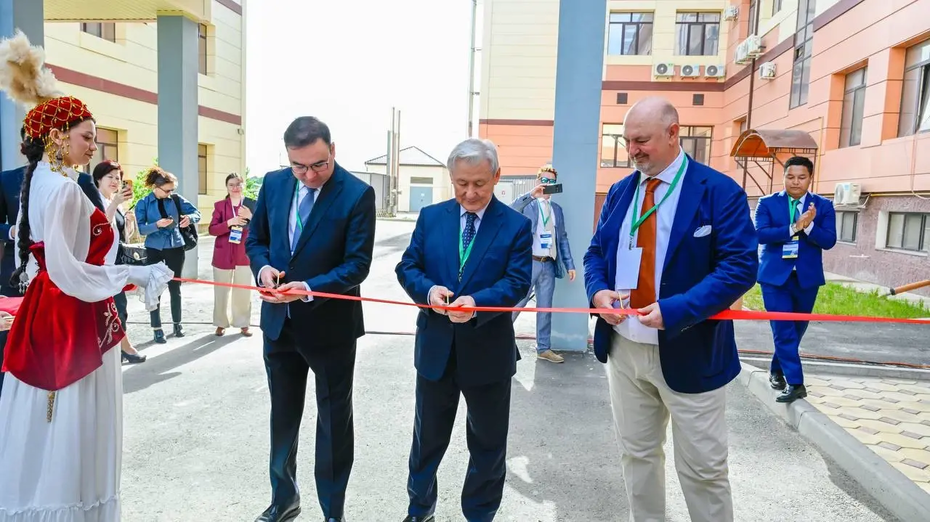
Recently, KMG Engineering—the technical and scientific arm of KazMunayGas—put into operation Kazakhstan’s inaugural full-cycle green hydrogen pilot at its Atyrau branch. Set in an oil-dependent region on the Caspian shore, the complex unites a 200 kW solar photovoltaic plant, a containerized electrolyzer, on-site consumption of hydrogen for heating and power, and a live research platform for advanced storage and hybrid energy configurations. This marks the first time that renewable generation, green hydrogen production, hydrogen storage development, and industrial application have been co-located in Kazakhstan, offering a template for hydrogen infrastructure across Central Asia.
- The pilot extends a 200 kW PV array with 336 modules, installed in partnership with Green Spark, to generate grid-input electricity at the Atyrau laboratory facility.
- A containerized electrolyzer was added to convert solar power into hydrogen via water splitting, enabling testing under variable load and intermittent generation.
- On-site hydrogen feeds both thermal boilers and backup generators, displacing diesel and natural gas to evaluate performance under real industrial loads.
- R&D led by Dr. Saule Zholdayakova focuses on titanium-iron metal hydride beds that can store and release hydrogen at near-ambient conditions.
- A Digital Hydrogen Atlas overlays solar and wind resource maps with grid access and water availability to estimate regional cost curves for green and blue hydrogen.
By weaving together generation, production, storage, and use, the Atyrau pilot serves as a microcosm of a decarbonized energy hub. Instead of isolating electrolyzers or lab benches, engineers can monitor how solar fluctuations, storage heat management, and end-use demands interact—data that is often missing in standalone research projects.
Technical Highlights
The 200 kW solar field captures roughly 300 MWh per year under western Kazakhstan’s high irradiation. Its direct-current output feeds an AC/DC converter and prioritizes electrolyzer input when marginal cost of solar power falls below grid tariffs. The containerized proton-exchange membrane (PEM) electrolyzer now operates at variable current densities between 0.5 and 2 A/cm², allowing teams to benchmark energy consumption—currently around 55–60 kWh per kg of hydrogen—against best-in-class figures. Real-time sensors record cell voltage, water purity, and hydrogen pressure, and remote-control software adjusts stack temperature to optimize efficiency during peak solar hours.
On the storage front, metal hydride vessels containing a titanium-iron alloy can absorb up to 1.5 wt% hydrogen at moderate pressures (20–30 bar) and ambient temperature. When hydrogen demand spikes, thermal jackets heat the beds to release the gas back to 5–10 bar, directing it to fuel cells or burners. Initial cycling experiments show stable absorption-desorption kinetics over dozens of cycles, suggesting acceptable durability for pilot-scale use. Researchers are comparing hydride performance with compressed gas storage at 35 bar, aiming to quantify trade-offs in volumetric density and system safety.
Strategic Context
KazMunayGas has signaled that hydrogen and alternative energy technologies will underpin its long-term decarbonization strategy, aligned with Kazakhstan’s goal of carbon neutrality by 2060. Testing the full production loop at an industrial site allows the company to assess retrofitting potential in its own refineries and power plants. Hosting the International Hydrogen Energy Seminar at Atyrau also underscores a broader ambition to attract foreign partnerships and technology transfer. On the policy front, the Digital Hydrogen Atlas informs regulators and investors where green and blue hydrogen could be most competitive, supporting grant schemes and offtake tender design. At the same time, the Ministry of Energy is drafting hydrogen tariff structures and safety standards, and the Finance Ministry is evaluating incentive schemes for electrolyzer imports and local manufacturing. Insights from Atyrau help close data gaps in cost and performance, informing national regulations and support mechanisms.
Beyond KMG, academic actors like Nazarbayev University are working on independent green hydrogen platforms, indicating a maturing domestic innovation ecosystem. Private players such as Green Spark are stepping in to install solar arrays and localize supply chains, while international development agencies are evaluating Kazakhstan as a potential exporter of clean hydrogen and ammonia to Europe and East Asia.
Perspective
In a region famed for oil, embedding a green hydrogen pilot within an operating petroleum R&D site may appear symbolic, but it carries tangible benefits. Engineers learn how to manage water resources in semi-arid steppe, mitigate dust on PV modules, and implement safety protocols for hydrogen handling. The Digital Atlas data-driven approach can reduce site-selection risk and channel capital toward promising zones, while hydride storage research tackles one of hydrogen’s toughest logistical challenges.
Challenges remain: scaling from a 200 kW pilot to multi-megawatt electrolysis will require robust supply chains for electrolyzer stacks, catalysts, and storage materials. Water availability remains a constraint, especially if hydrogen is to supply heavy industry or ammonia synthesis inland. Investment in pipelines or compressor stations will be essential for longer-term market development, while regulatory clarity on tariffs and standards is still evolving.
Looking ahead, integrating onshore wind alongside solar could raise electrolyzer capacity utilization. Pairing the Atyrau platform with modular ammonia synthesis units would create a clear export product, tapping into demand in Europe and East Asia for clean ammonia as a shipping fuel or fertilizer feedstock. Early feasibility studies point to the Mangystau corridor as a prime site for multi-gigawatt green ammonia, but real-world data on hydrogen storage methods, water consumption, and hybrid renewable integration from Atyrau will guide those larger schemes.
Ultimately, the Atyrau pilot shows that making hydrogen economics work is as much about mastering control algorithms, thermal management of hydride reactors, and solar maintenance in dusty environments as it is about headline capacity numbers. By turning policy aspirations into operational practice, Kazakhstan is adding technical credibility to its hydrogen ambitions—one cycle at a time.