We fact-checked 100 hydrogen-infrastructure projects announced in 2023–24
We verified 100 hydrogen-infrastructure projects announced in 2023–24 against live sources: half built, a third still just plans, almost none officially cancelled.
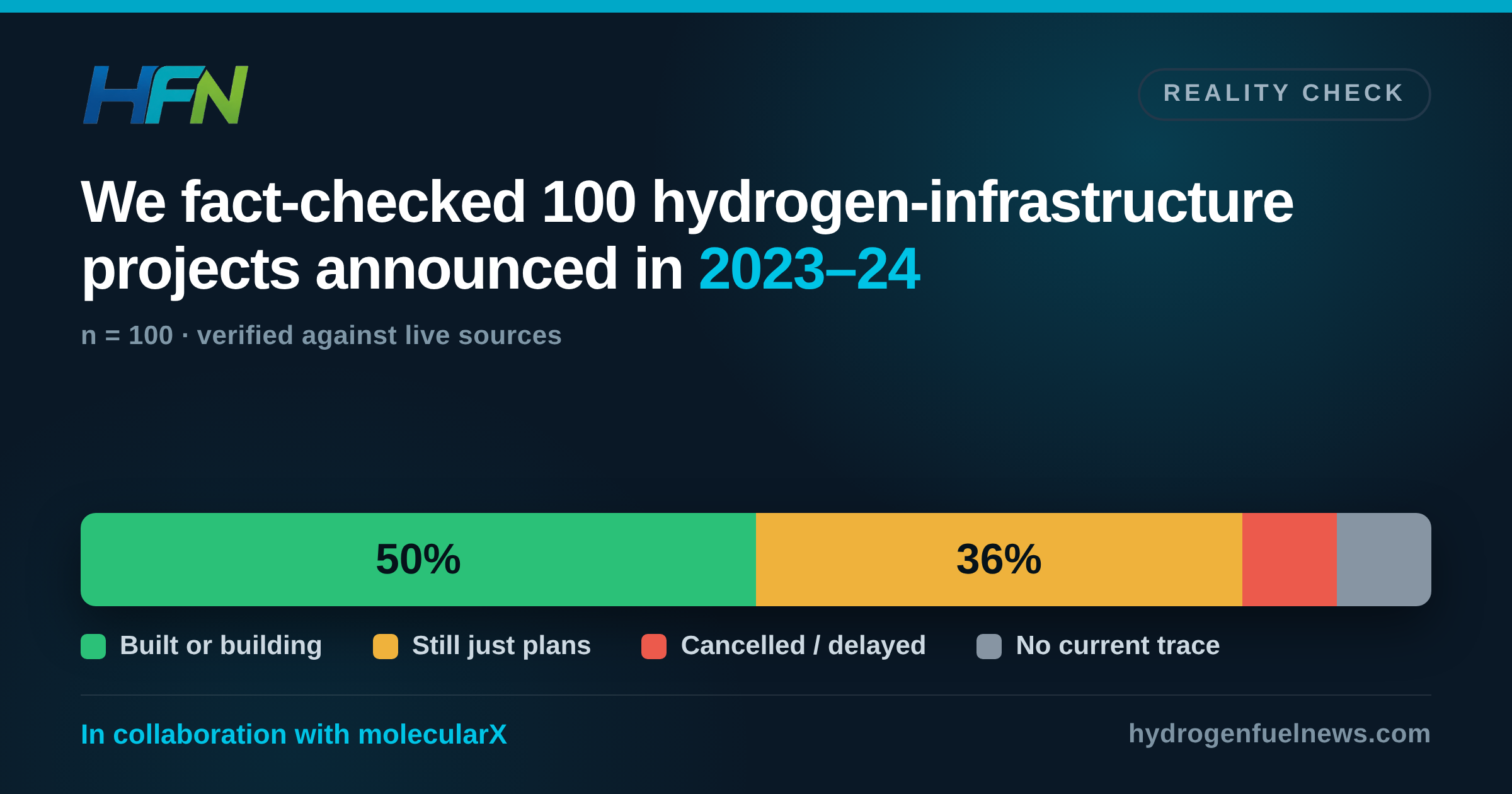
Two years ago the hydrogen-infrastructure space was a headline machine — refuelling networks, cross-border pipelines, regional hubs, and so-called "world-first" facilities announced in rapid succession. The press releases were frequent. Actual delivery was not. So, in collaboration with molecularX, we checked 100 of those projects one by one against current sources to see what had actually happened. The exercise produced a clear pattern: the sector announces loudly and fails quietly, while quietly building a substantial base of real infrastructure underneath the noise.
Drawing on Hydrogen Fuel News's curated hydrogen-intelligence database, we reviewed every infrastructure project first announced in 2023–24 that remained listed as "planned" or "announced." From that pool we sampled 100 projects and verified each project's current status. The headline split is stark and specific: half (50%) have progressed to construction or operation; just over a third (36%) remain at the same stage they were first reported; 7% were formally cancelled or delayed; and another 7% have gone so quiet we could find no current trace at all.

The full breakdown
| Current status (verified) | Projects | Share | Group |
|---|---|---|---|
| Operational | 44 | 44% | Built / building |
| Under construction | 6 | 6% | Built / building |
| Planned | 30 | 30% | Still on paper |
| Announced | 6 | 6% | Still on paper |
| Cancelled | 6 | 6% | Cancelled / delayed |
| Delayed | 1 | 1% | Cancelled / delayed |
| No current trace | 7 | 7% | Unverifiable |
A third never left the drawing board
More than a third of the projects we checked remain where they began — labelled "planned" or "announced," with no ground broken years later. That is not a marginal phenomenon. Among the projects stalled in limbo are some of the sector's better-known initiatives: Europe's Iberia-to-France hydrogen corridor, H2Med, is still pre-final-investment-decision; MachH2, a US Department of Energy regional hub, is still in Phase 1; and refuelling build-outs from California to Australia remain plans on paper. These are not obscure proposals. They are widely publicised projects that have not moved into execution.
The industry doesn't kill projects — it forgets them
One finding reframes the usual hype-versus-reality argument: only 7% of the sampled projects were ever officially cancelled or delayed. Formal cancellations are uncommon. Instead projects drift into permitting-and-FID limbo and then largely stop being mentioned. The "announced" column behaves less like a working pipeline and more like a waiting room. In practice, half the hydrogen pipeline you read about never progressed beyond announcement, yet barely one in fourteen carried a formal cancellation notice.
When they do die, it is loud: the Nikola graveyard
The cancellations we could confirm are concentrated in a single, highly visible collapse. Nikola filed for Chapter 11 in February 2025, and its hydrogen ambitions went down with it — the HYLA refuelling network was dismantled and its assets sold off, and a DOE-backed Southern California station programme had its funding rescinded. When infrastructure projects fail, they often take a flagship name with them, and that amplifies the news coverage.
But half of it actually got built
There is a counterweight to the stalled and the quiet: half of the sampled projects have moved to construction or operation. Some items we had recorded as mere "plans" quietly reached execution. A hydrogen-powered AI data centre went live in California, which its operator ECL calls the world's first. Portugal began blending hydrogen into its gas grid. Fleet-refuelling networks opened across three continents. Those are concrete, operational developments. They involve pipes, dispensers and commissioning tests — the unglamorous work that makes a hydrogen economy functional, rather than just theoretical.
The verdicts — what the database said vs. what we found
| Project | Verified status | As of |
|---|---|---|
| ECL hydrogen AI data center (was: planned) | Operational | 2026-10 |
| Portugal 10% grid H₂ blending (was: planned) | Operational | 2026-10 |
| Hirnga refueling network (NZ) (was: planned) | Operational | 2026-10 |
| enerPort II (Germany) (was: planned) | Operational | 2025-07 |
| North Adriatic Hydrogen Valley (was: announced) | Under constr. | 2026-09 |
| UK National hydrogen network (was: planned) | Under constr. | 2026-10 |
| H2Med / BarMar corridor (was: planned) | Planned | 2026-10 |
| MachH2 (DOE Midwest hub) (was: planned) | Planned | 2024-12 |
| Latrobe Valley Energy Hub (was: planned) | Planned | 2026-10 |
| Nikola HYLA network (was: planned) | Cancelled | 2025-04 |
| Southern California H₂ stations (was: announced) | Cancelled | 2025-08 |
The takeaway
Hydrogen infrastructure is neither all hype nor entirely delivered. The reality sits between those extremes, and it is harder to summarise in a single tweet. What the data show is this: half of announced projects genuinely progress to construction or operation; roughly a third stall indefinitely at the planning stage; a small share is formally cancelled; and another small share vanishes from public view. Announcements are plentiful and cost-free. Building infrastructure is difficult and resource-intensive. If you want to know whether a particular project will matter, you must check it, project by project, against the public record. The plumbing, not the press release, will determine whether and when a real hydrogen economy emerges.
This analysis was produced in collaboration with molecularX (molecularx.io), which works to set realistic expectations over molecular-energy projects — hydrogen and its derivatives such as ammonia, methanol and e-fuels — applying data and source-checked along with expert analysis to the harder question of whether a project will actually deliver, and by when.