India's Electrolyser Manufacturing Delays: Navigating Market Demand and Policy Incentives
India's green hydrogen initiatives face delays in electrolyser manufacturing, highlighting a mismatch between production capacity and market demand, as major companies seek to postpone commissioning.
In a significant twist for India's green hydrogen ambitions, notable electrolysers such as Reliance Electrolyser Manufacturing Limited, Adani New Industries Limited, homiHydrogen Private Limited, and John Cockerill Greenko Hydrogen Solutions are reportedly seeking to postpone the commissioning of their manufacturing facilities, originally slated for 2026, to August 2027. The request to defer timelines highlights a persistent problem in the sector: an imbalance between awarded manufacturing capacity and the actual demand coming from downstream projects that still need binding purchase orders and financial closure. Developers and manufacturers won the factory awards. Yet many downstream buyers have not finalised the contracts and financing required to take delivery and run plants at scale. As a result, companies face a choice between starting production now with substantial operational costs or holding back to align output with confirmed offtake.
The Nation Green Hydrogen Mission launched by India's government aims to position the country as a leader in green hydrogen production and its derivatives. Launched in early 2023, the mission’s $2.4 billion budget focuses on fostering local electrolyser production alongside hydrogen generation. The Solar Energy Corporation of India (SECI) has already identified key manufacturers to develop 3,000 MW of electrolyser capacity. Those awarded projects together signal a large-scale industrial push. But the original deadlines are coming under scrutiny because the downstream market has yet to fully crystallise into binding demand.
The Underlying Dynamics: Supply Meets Demand
The hesitation to move forward centers on a critical supply-demand balance. Despite ambitious projects being approved and manufacturers like Reliance, Adani, and John Cockerill receiving substantial factory awards, industry reports indicate that numerous green hydrogen initiatives have yet to secure reliable financing or order commitments from customers. Essentially, as manufacturers finalise plans for massive production capacities—totaling at least 1,500 MW in the first tranche—there is concern that the demand side is not evolving quickly enough to match this newfound capacity. That mismatch creates exposure: idle plant capacity would carry fixed costs whether it produces hydrogen or sits idle awaiting customers.
Companies now confront a practical dilemma. Start up and absorb operational expenses, or delay commissioning to preserve cash and, potentially, eligibility for policy incentives. According to insider reports, this decision could be a strategic approach to managing financial risk rather than a sign of technological failure. The calculus is partly financial and partly contractual: without binding purchase orders and financial closure, producing electrolysers at scale risks leaving manufacturers with inventory and no guaranteed market for their output. Delaying commissioning, in this framing, is a way to time production to when offtake is secure.
Exploring the Technological Landscape
Electrolysis technologies like Alkaline water electrolysis and PEM electrolysis are integral to hydrogen production. Alkaline systems, which utilise robust and mature components, dominate India's planned electrolyser market, with many of the awarded capacities focusing on this traditional technology. PEM systems—known for their rapid response capabilities—are gaining traction for applications needing more compact equipment. The two approaches address different needs: one relies on established components and scale, the other on flexibility and fast dynamics in power input.
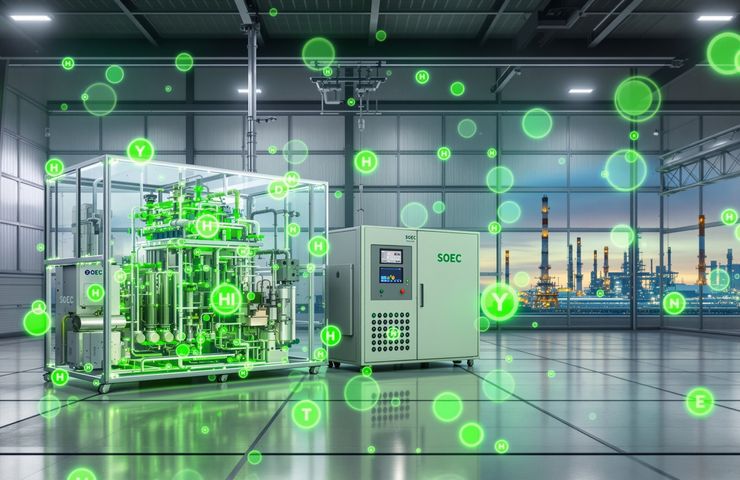
In addition, the inclusion of other technologies such as solid-oxide electrolysis and AEM electrolysis expands the potential landscape for hydrogen production, suggesting a diversity of approaches as manufacturers seek to innovate and improve efficiencies. For instance, homiHydrogen has indicated its commitment to utilising multiple technologies, aiming to remain versatile in a rapidly changing environment. That stated versatility may allow some manufacturers to pivot between technology types as market signals and policy incentives evolve, though it also complicates planning for standardised production lines and supply chains.
Government Policy and Market Timing
The original projections by SECI reported that by December 2025, various companies would have been able to produce 3,000 MW of annual electrolyser capacity. However, the industry is now grappling with the realisation that these advanced plans may not result in immediate operational plants due to lingering uncertainties in order volumes. The Indian government has reportedly allowed these firms to defer their commissioning deadlines to 2027, as the recent industry narrative suggests. That reported flexibility has not been documented in an official, public schedule, leaving observers uncertain whether the extension will be formalised and under what conditions.
Timing matters. The intersection between manufacturers and policy makers is crucial here. Production targets depend heavily on downstream demand materialising into confirmed contracts and financing. Without those commitments, large electrolysis facilities risk running below capacity for significant periods, eroding the economic rationale behind rapid local manufacturing. Conversely, if offtake and project financing accelerate, deferred factory start-ups could be brought online in step with validated demand, reducing waste and synchronising supply chains.
Looking Ahead: Opportunities and Implications
What does this mean for India's broader hydrogen ambitions? The deferral of commissioning represents not just a logistical challenge, but a critical juncture for the country's industrial decarbonisation strategy. If timely action is taken regarding demand-side procurement, coupled with a clear strategy for renewable energy integration, these delayed capacities could eventually provide much-needed supply stability, aiding in the transition to a more sustainable energy landscape. In that scenario, factories would be brought online when offtake is in place, and manufacturing scale could help lower costs over time.
On the other hand, prolonged uncertainty on the demand side may slow momentum, leaving planned capacities underused and policy objectives unmet. The coming period will test whether the market can convert declared ambitions and awarded factory projects into concrete, financed hydrogen initiatives. For manufacturers and policymakers alike, co-ordination on procurement timelines, contract structures and financing mechanisms will be central to closing the gap between capacity and demand.
Ultimately, the coming years will be pivotal for assessing how these dynamics evolve. With the world looking towards greener alternatives, India's journey towards a self-sufficient green hydrogen economy is one to watch closely. Will there be a resurgence in investments and confidence in the industry? Or will the challenges continue to overshadow this ambitious venture? Only time will tell.