FuelCell Energy's New Project Aims to Power AI Data Centers with Integrated Fuel Cell Systems
FuelCell Energy embarks on the StabilityMax project to explore integrated power solutions for AI data centers, reinforcing the potential of fuel cell technology in meeting evolving energy demands.
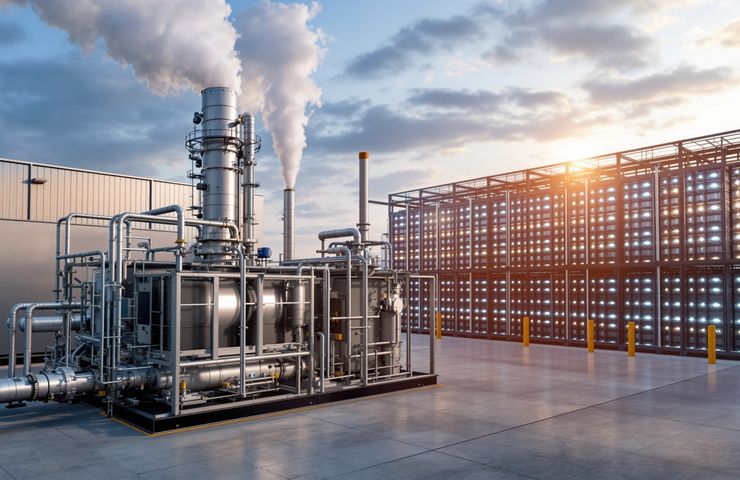
FuelCell Energy, Inc. said it will take part in a collaborative effort called StabilityMax, aiming to test how fuel cells can be combined with other technologies to serve the power needs of AI data centers. The company plans to use a manufacturing facility in Connecticut as part of that work.
StabilityMax is spearheaded by the U.S. Department of Energy’s National Laboratory of the Rockies and also sees participation from the esteemed Argonne National Laboratory. Though the project is structured as a three-year research collaboration rather than a direct commercial development of AI data infrastructure, it points to a new line of inquiry about how fuel cells might work alongside emerging AI technologies.
Understanding the Project's Framework
The stated goal of StabilityMax is to build a testbed that evaluates fuel cells alongside batteries, advanced controls and power electronics, matching them to the dynamic electricity needs of modern AI workloads. AI applications can produce rapid swings in demand. Those swings put pressure on both power quality and availability.
Project teams will aim to generate realistic AI data-center load profiles to guide simulations and hands-on trials. The profiles are meant to recreate the kinds of demand spikes, drops and transient events that occur in practice, so the integrated systems can be measured under conditions that mirror real operations. In short: the tests will ask whether voltage and power quality can be held within acceptable limits as loads change.
Fuel cells are central to that test strategy. FuelCell Energy's carbonate fuel cells will serve as a primary energy source, operating at elevated temperatures that enable continuous electricity delivery. Paired with batteries and electronic controls, the fuel cells are expected to be part of an architecture designed to provide both steady output and the flexibility needed when AI tasks surge.
Technical Insights into Fuel Cell Integration
At the heart of the work is the integration of multiple components into a single power architecture. The testing regimen will combine fuel cells with battery energy storage to absorb peaks and smooth fast transients, while advanced power electronics and controls will manage the interactions among those elements. That interplay seeks to give fuel cells the steady operating conditions in which they are most efficient, without surrendering the responsiveness required by AI data-center loads.
Engineers will use the synthetic load profiles to exercise control algorithms and power-electronic systems, observing how quickly the integrated system responds to changes and how well it preserves voltage and frequency. The combination of storage and continuous generation is intended to provide a buffer: batteries handle the short, sharp swings; the fuel cells supply sustained energy and recover stored charge over longer cycles.
Testing will also probe points of failure and recovery, looking at scenarios where grid support is limited or intermittent. In those cases, the demonstration will show whether the combined system can reduce dependency on the grid while still meeting the data center’s reliability requirements.
Strategic Implications for FuelCell Energy
For FuelCell Energy, the project aligns with an ongoing expansion at its Torrington manufacturing facility—set to build capacity up to 500 MW annually by 2028—which could position the company to supply larger-scale systems if the technology proves practical for data-center applications. Demand for resilient, lower-emissions power is rising alongside the electricity needs of AI workloads, and the Torrington build-out is a stated part of how the company expects to meet that market.
The initiative also feeds into a broader conversation about energy infrastructure in Connecticut. Local communities have raised concerns about environmental impacts tied to data center expansions, and officials and developers alike are looking for energy approaches that reduce those impacts. StabilityMax places fuel cells and hybrid power systems into that policy and public debate by testing whether they can deliver cleaner, reliable power at scale.
Long-Term Considerations
Caution accompanies the technical promise. Skepticism remains about the direct commercial viability of the systems under study, and the project is explicit about its research focus rather than immediate market deployment. Future public data from StabilityMax will be important; the engineering evidence produced through measurable testing will offer the metrics needed to compare fuel-cell-based architectures against the traditional grid and other renewable options.
How the measured results translate into cost, deployment timelines and regulatory acceptance is a separate set of questions that the project is not claiming to answer immediately. What the testbed can provide is empirical data on performance, response times and power quality under realistic load traces—information that potential customers, regulators and grid operators can use when assessing alternatives.
There are broader policy implications as well. Data centers are projected to account for a significant share of U.S. electricity consumption by the end of the decade, and that trajectory has intensified interest in diverse approaches to supply, storage and grid interaction. FuelCell Energy’s involvement in StabilityMax places the company among the parties exploring those approaches, while the research focus keeps expectations grounded in technical verification rather than sales claims.
While the road ahead for StabilityMax is still being paved, the project will produce concrete test results that inform the debate over integrated energy systems for data centers. The collaboration is an early step in assessing whether fuel cells, paired with batteries and modern controls, can offer a reliable and lower-emissions alternative to current power models.