Changchun Institute’s review outlines earth-abundant catalysts that could slash electrolyzer costs
Changchun Institute’s review outlines earth-abundant catalysts that could slash electrolyzer costs and boost scalable green hydrogen production.
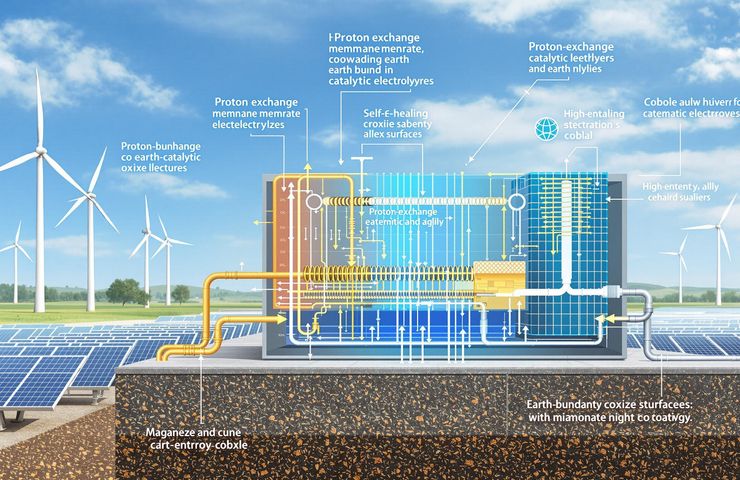
A new deep-dive review from the Changchun Institute of Applied Chemistry, led by Dr. Meiling Xiao, lays out the hottest breakthroughs in non-noble metal catalysts for cutting costs and boosting durability in proton exchange membrane water electrolysis (PEMWE) under acidic conditions. Published in eScience on February 1, 2025, it rolls out fresh design hacks—think self-healing chemistries and high-entropy alloys—to rival pricey iridium and ruthenium catalysts. Best of all, by zeroing in on earth-friendly metals like manganese and cobalt, it tackles the cost hurdle that’s been holding back large-scale green hydrogen production.
Background: The Cost Bottleneck in Green Hydrogen Production
For years, anyone following hydrogen production knows noble metals have been a thorn in the side of electrolysis. In a standard PEMWE setup, the anode’s oxygen evolution reaction practically begs for expensive iridium or ruthenium to keep activity and stability up in that acidic environment. But with supplies tight and prices bouncing all over the place, green hydrogen ends up costing roughly $4–12 per kilo—way steeper than grey hydrogen’s $1–3. That price gap hasn’t just pinched wallets; it’s put the brakes on investment in hydrogen infrastructure and held back zero-emission options in heavy industry, shipping, and chemical sectors.
Methodology and Scope
To get a handle on the field, the team sifted through over 200 studies, sorting catalyst designs by material family, synthesis pathway, and how they actually perform in acidic setups. They zero in on lab-scale hits—think acid-stable transition metal oxides—and call out where long-term durability tests are missing, always holding new contenders up against commercial iridium. This approach makes sure they’re not just theorizing but actually looking at bench-tested results you can trust. By charting structure–function links, they’ve sketched out straightforward design rules that could steer the next wave of catalyst innovation.
Innovations in Non-Noble Metal Catalysts
What really jumps out is how a few clever engineering tricks are taming the brutal conditions inside a PEMWE anode. Here’s what they’ve cooked up:
- Self-healing catalysts: Mix in dynamic surface chemistries that redeposit active metal ions and patch up oxidation damage right on the spot.
- Acid-stable oxides: Craft mixed-metal oxides—like those cobalt–manganese spinels—that laugh in the face of proton-driven wear and tear.
- High-entropy alloys: Build multi-element frameworks where team dynamics among elements not only amp up activity but stop any one metal from leaching out.
In lab tests, prototype electrodes loaded with these ideas pulled off oxygen evolution current densities on par with their iridium rivals and ran steady for more than 100 hours at 1 A/cm2. They’re not yet hitting industrial lifespans, but it’s a big leap toward making non-noble metal catalysts a practical reality.
Market Implications and Cost Outlook
If these non-noble catalysts make the jump to scale, we could be looking at a 70% haircut on catalyst expenses, chopping down the CAPEX for PEMWE stacks in a big way. Since green hydrogen production today sits in that $4–12/kg ballpark, even shaving off 30% on upfront gear costs could nudge electrolysis into viable territory—particularly where renewable electricity is dirt cheap. And with more policy perks and carbon levies on the horizon, having cost-effective, scalable catalysts will be crucial if we want to beef up green hydrogen in a big way.
Impacts Beyond Hydrogen Infrastructure
But these breakthroughs don’t stop at hydrogen infrastructure. Cutting back on scarce metals eases geopolitical headaches, while the same smart tricks could turbocharge progress in fuel cells, CO2 reduction, and next-gen batteries. Plus, when catalysts get cheap, you open doors for emerging markets to jump on the clean energy train—expanding the reach of sustainable energy projects around the world.
About the Research Team
The Changchun Institute of Applied Chemistry isn’t new to this game—it’s one of China’s top hubs for materials science under the Chinese Academy of Sciences. Famous for pushing boundaries in energy storage and catalysis, they’ve spearheaded major national programs on hydrogen tech. And Dr. Meiling Xiao, the co-corresponding author here, has built her reputation on crafting versatile catalysts and has racked up a slew of papers on electrocatalytic water splitting.
Looking Ahead
There’s still work to do before these non-noble catalysts can go pro. Next steps include stress-testing under real-world load swings and scaling up to big-area membrane electrode assemblies. On the flip side, progress hinges on smart system integration, pilot demos, supportive policy, and everyone—from academics to regulators—pulling in the same direction. If all that lines up, we could see a serious shake-up in electrolysis and green hydrogen economics. In the meantime, this review hands us a clear blueprint to fast-track the next wave of wallet-friendly catalysts for water splitting.
Concluding Remarks
All in all, this review lays out a practical roadmap for non-noble metal catalysts in acidic electrolysis—blending deep insights with hands-on design tips. As the world scrambles to ramp up green hydrogen and slash emissions in heavy industries, getting costs down and securing supply chains for catalysts is make-or-break. With the right mix of academic smarts, industry muscle, and policy backing, these earth-abundant materials could open the floodgates to affordable, game-changing hydrogen production.