India’s National Green Hydrogen Mission Could Leverage ₹8–10 Lakh Crore for Green Hydrogen Production by 2030
India’s National Green Hydrogen Mission targets 5 mtpa production by 2030 with ₹19,744 crore in public funding and could attract up to ₹10 lakh crore in private investment, says Mission Director Abhay Bakre.
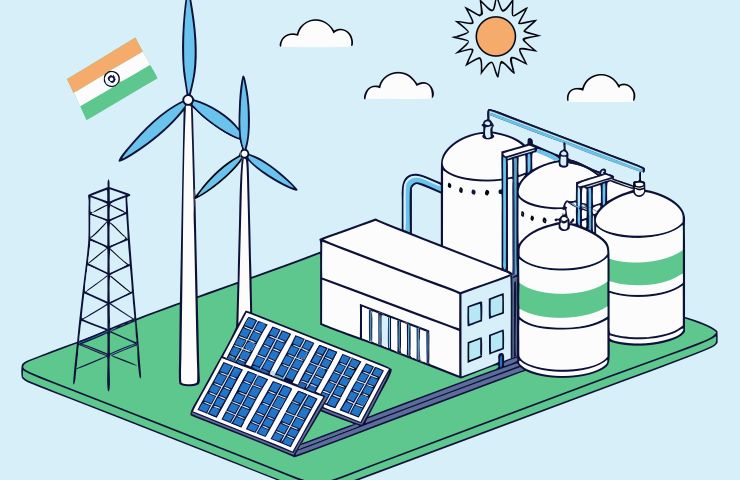
Abhay Bakre said that India’s National Green Hydrogen Mission could attract ₹8–10 lakh crore in green hydrogen production investment by 2030, under a framework approved by the Union Cabinet and coordinated by the Ministry of New and Renewable Energy.
Mission Overview
The National Green Hydrogen Mission was approved by the Union Cabinet in early 2023 with an initial outlay of ₹19,744 crore, according to a Government of India press release. It is coordinated by the Ministry of New and Renewable Energy. The stated aim is to position India as a global hub for green hydrogen and its derivatives, including green ammonia and green methanol, according to the mission framework. The framework also assigns responsibilities for overall coordination, scheme guidelines, certification arrangements and ecosystem development across production, domestic use, exports, electrolyser manufacturing, research, pilot projects, infrastructure and skills, according to the Ministry of New and Renewable Energy.
Public Financing and Targets
Under the Strategic Interventions for Green Hydrogen Transition (SIGHT) programme, ₹17,490 crore is allocated to domestic electrolyser manufacturing and production incentives, according to the mission portal. Pilot projects receive ₹1,466 crore, research and development ₹400 crore, and other components ₹388 crore, according to the press release. The mission sets a 2030 target of at least 5 million metric tonnes of annual green hydrogen production supported by approximately 125 GW of associated renewable electricity capacity, according to the mission framework. The government also projects more than 600,000 jobs and nearly 50 million tonnes of CO₂ emissions avoided by 2030, according to the press release.
Private Investment Projection
Public funds are geared toward early-stage costs. Private capital is expected to carry much of the build-out. The mission director indicates that private and associated infrastructure spending could reach ₹8–10 lakh crore for hydrogen production alone by 2030, according to statements by Abhay Bakre. Official government materials describe a lower-bound expectation of more than ₹8 lakh crore in combined investment to achieve the mission’s production and renewable-capacity targets, according to a Government of India press release. The ₹10 lakh crore upper figure remains a forecast attributed to the mission director rather than a confirmed pipeline of capital commitments.
This projected scale of investment covers several discrete components already outlined in the framework: wind and solar power deployment, electrolyser stack manufacturing, green hydrogen storage solutions and infrastructure such as pipelines and export terminals. Embedding private capital at this scale is intended to complement government incentives, reduce risk perceptions and mobilise long-term offtake agreements with industrial users. However, the framework makes clear that reaching the upper bound depends on specific conditions — cost reductions in electrolysis, securing affordable renewable power through dedicated supply and establishing credible certification mechanisms for green hydrogen and its derivatives.
Technology Focus
Green hydrogen production in this mission relies on renewable-powered water electrolysis, a process that splits water into hydrogen and oxygen using electricity, according to the mission framework. Electrolysers are described as collections of multiple electrochemical cells assembled into stacks; these convert renewable electricity and treated water into hydrogen. Performance varies with the choice of alkaline or polymer-electrolyte-membrane technology, system efficiency and operating conditions. The SIGHT programme’s support for domestic electrolyser manufacturing aims to build local supply chains and reduce import dependence.
Beyond pure hydrogen, the mission identifies green ammonia and green methanol as key derivatives. Green ammonia is synthesised by combining renewable hydrogen with nitrogen, offering a transportable carrier for hydrogen that also serves fertiliser markets. Green methanol production integrates hydrogen with a carbon feedstock, with overall emissions depending on the carbon source and lifecycle impacts. Developing synthesis plants and handling infrastructure is central to the mission’s export ambitions.
Hydrogen storage and distribution infrastructure, the framework notes, encompasses compressed or liquefied storage, pipeline networks, tanker loading facilities and conversion hubs. The mission calls for the creation of hydrogen hubs near industrial clusters and port facilities to link domestic production with refineries, fertiliser plants, steel mills and shipping routes. Those links are presented as critical for integrating green hydrogen into existing industrial processes and for scaling exports.
Market Implications
The National Green Hydrogen Mission framework highlights potential decarbonisation applications in petroleum refining, ammonia production, steel, chemicals, shipping and mobility, according to the mission framework. By fostering domestic electrolyser manufacturing, the mission aims to capture value in high-growth equipment markets. Export strategies focus on green ammonia as an intermediate energy carrier, leveraging India’s port infrastructure and competitive renewable power tariffs, according to the mission framework. Long-term power purchase agreements and green hydrogen offtake contracts will be essential to underpin project finance, according to the mission framework.
Challenges and Requirements
Realising the mission’s full potential hinges on several challenges. Ensuring reliable access to low-cost renewable electricity requires dedicated generation capacity and grid prioritisation, alongside transmission-charge waivers for electrolysis projects, according to mission guidelines. Water sourcing and treatment must be managed responsibly, particularly in water-stressed regions, to avoid environmental trade-offs. Developing a robust certification and standards framework is critical to guarantee that hydrogen labelled as green meets lifecycle emissions criteria, according to the Ministry of New and Renewable Energy.
On the financial side, lowering capital costs for electrolysers and improving system efficiency are ongoing imperatives. Cost declines in stack materials and manufacturing process efficiencies will determine the viability of projects seeking high-rate capital deployment. Infrastructure investments in storage tanks, pipelines and export terminals demand coordinated planning and cross-sector partnerships. Securing bankable offtake contracts with industrial users and utilities is presented as essential to mitigate revenue risks and attract long-term financing.
Looking Ahead
As India moves towards the 2030 horizon, the interplay between policy incentives and private-sector appetite will shape the mission’s trajectory. Government measures such as the SIGHT programme, pilot project support and streamlined approvals aim to lower barriers to entry, but market fundamentals like production costs and offtake certainty will ultimately drive investment volumes.
Stakeholders will monitor early project bids, electrolyser deployment and the establishment of green hydrogen certification processes as leading indicators of market maturity. If the mission delivers on its targets, India could emerge as a competitive exporter of green hydrogen derivatives, bolstering industrial decarbonisation and energy security. Achieving economies of scale in renewable generation and electrolyser manufacturing will be key to unlocking the upper end of the investment projection.