Hydrogen news
Sandia turns its focus on underground hydrogen storage
Could repurposed petroleum reservoirs be used to store clean H2? As the world decarbonizes and focuses on options such as clean H2, locating hydrogen storage options has become an important goal to ensure sustainable and reliable energy to meet global demands. Many different options are being considered, among which now include the empty petroleum reservoirs. Researchers are conducting simulations to determine feasibility Sandia National Laboratories scientists have been working on these simulations as well as laboratory experiments to determine whether depleted oil and natural gas reservoirs…

Could repurposed petroleum reservoirs be used to store clean H2?
As the world decarbonizes and focuses on options such as clean H2, locating hydrogen storage options has become an important goal to ensure sustainable and reliable energy to meet global demands. Many different options are being considered, among which now include the empty petroleum reservoirs.Researchers are conducting simulations to determine feasibility
Sandia National Laboratories scientists have been working on these simulations as well as laboratory experiments to determine whether depleted oil and natural gas reservoirs could be used for a new purpose in the form of hydrogen storage. This could allow the same locations – and the infrastructure that serves them – to be used for the clean energy as it replaces fossil fuel. Storing H2 is particularly important when it comes to green hydrogen made using renewable energy such as wind and solar power. The reason is that those sources of electricity are not necessarily consistently available, depending on wind and daylight with full sun exposure to be at their best. [caption id="attachment_64238" align="aligncenter" width="1200"]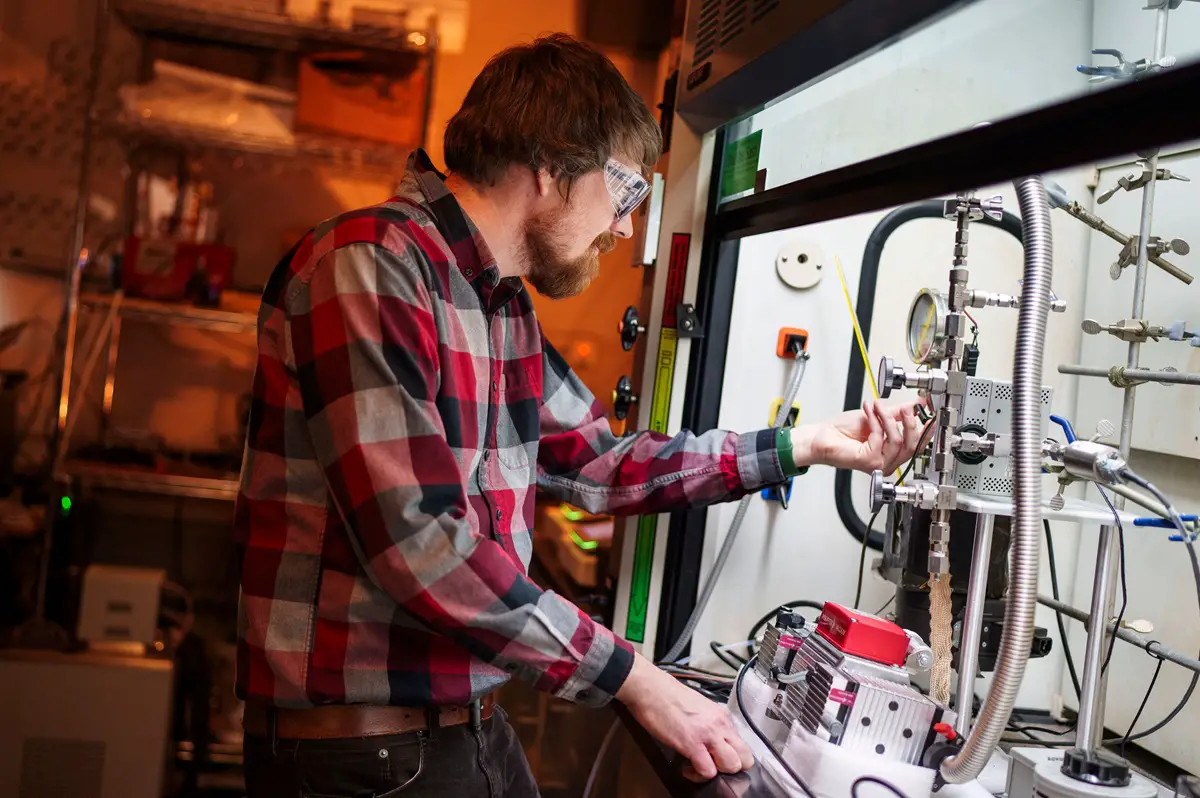 Matthew Paul works with a binary gas adsorption system in a fume hood while researching if depleted oil and gas reservoirs can be used for storing hydrogen fuel. Photo by Craig Fritz[/caption]
Using hydrogen storage for greener energy
By storing the renewable H2, it’s possible to ensure that when renewable electricity is being generated in greater amounts than is needed to meet demand, the excess can be stored until times when there is not enough electricity being generated to meet demand. Empty petroleum reservoirs have the potential to offer this type of large-scale, long-term storage solution that would not only help to offset fluctuations in renewable electricity production from day to day, but also from season to season as weather patterns change. [caption id="attachment_64235" align="aligncenter" width="1200"] Tuan Ho, who is leading research at Sandia National Labs to see if depleted oil and gas reservoirs can be used for storing hydrogen fuel. Photo by Craig Fritz[/caption]
“If you think of solar energy, in the summer you can produce a lot of electricity, but you don’t need a lot for heating,” said Tuan Ho, a chemical engineer at Sandia who is leading the hydrogen storage research. “The excess can be turned into hydrogen and stored until winter.”
Tuan Ho, who is leading research at Sandia National Labs to see if depleted oil and gas reservoirs can be used for storing hydrogen fuel. Photo by Craig Fritz[/caption]
“If you think of solar energy, in the summer you can produce a lot of electricity, but you don’t need a lot for heating,” said Tuan Ho, a chemical engineer at Sandia who is leading the hydrogen storage research. “The excess can be turned into hydrogen and stored until winter.”
Improved availability
Among the reasons that petroleum reservoirs are being considered as highly promising even when other options have been considered is that they are already in place, they are large enough, and they are expected to be appropriate for holding H2 gas. While salt caverns have been found promising for a similar purpose, the issue is that they are not widespread throughout the country. Though metal tanks on the surface can be used for transportation for specific purposes, underground options are most practical for larger volumes and over longer periods of time, as the metal tanks would need to be absolutely enormous and highly numerous to keep up with demand. Ready to test your knowledge on the most abundant element in the universe? Take our fun and engaging Hydrogen Quiz now! [forminator_quiz id="58712"]How was this article?
Thanks for the feedback!