LOHC Pioneer Wasserscheid Wins Archimedes Science Award
Prof. Peter Wasserscheid received the EUR 50,000 Archimedes Science Award 2026 in Dresden for his pioneering LOHC-based hydrogen storage, highlighting Saxony’s strategic focus on integrating chemical storage into hydrogen infrastructure.
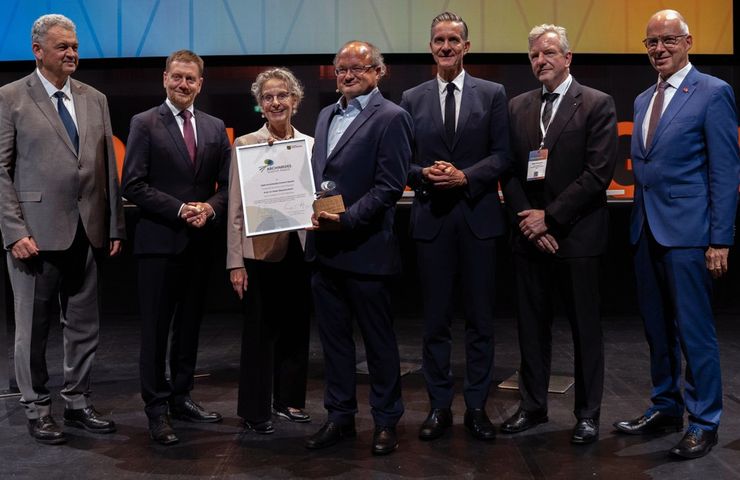
TUD Dresden University of Technology, the DRESDEN-concept Science and Innovation Alliance, and the Free State of Saxony recently awarded the EUR 50,000 Archimedes Science Award 2026 to Prof. Dr. Peter Wasserscheid during the international Building Bridges conference held in Dresden this September.
This award celebrates Wasserscheid’s impressive work over the years in chemical hydrogen storage, particularly utilizing liquid organic hydrogen carriers (LOHC). As a professor of Chemical Reaction Engineering at FAU Erlangen-Nürnberg and director at the Forschungszentrum Jülich’s Institute for a Sustainable Hydrogen Economy, he’s been instrumental in developing advanced catalyst materials and reactor designs. This work enables practical hydrogenation–dehydrogenation cycles using organic carriers like N-ethylcarbazole and dibenzyltoluene.
Initially given out in 2025, the Archimedes Science Award, which carries a nifty prize of EUR 50,000, recognizes those who have successfully taken hydrogen technologies from the lab bench to real-world applications. It’s presented each year at the “Building Bridges” conference, a gathering that highlights significant advancements in the hydrogen value chain, all under the auspices of the Saxon State Chancellery.
Strategic implications
The award ceremony reinforced Saxony’s commitment to weaving green hydrogen solutions into its high-tech ecosystem. The key takeaways include:
- Integration of hydrogen storage into the region's innovation priorities, alongside fields like microelectronics and photonics.
- A focus on technologies that can repurpose existing fuel terminals, which helps save on capital expenditures for new pipelines or cryogenic facilities.
- Enhanced collaborations between TUD Dresden, Helmholtz-Zentrum Dresden-Rossendorf, and Forschungszentrum Jülich.
Technical snapshot
LOHC systems utilize a reversible hydrogenation–dehydrogenation cycle. When hydrogenation occurs, renewable hydrogen sourced from electrolysis chemically bonds with a carrier liquid under heat and catalysts, creating a hydrogen-rich fluid that can be easily stored and transported in standard tanks. When it’s time to use the hydrogen, dehydrogenation reactors can release gaseous hydrogen for fuel cells or industrial processes, while regenerating the carrier. This method offers high volumetric density and safer handling compared to the more traditional compressed or liquefied hydrogen methods.
Main takeaways
- Market readiness: Hydrogenious LOHC Technologies has rolled out demonstration units globally, showing there's genuine commercial interest.
- Policy alignment: Both Saxony and Germany’s hydrogen strategies now incorporate downstream storage along with production.
- Cost leverage: LOHC’s compatibility with standard tanks and fuel logistics can significantly reduce integration costs.
- Buffering renewables: Liquid storage helps manage unpredictable power sources and supports transportation over long distances.
Broader context
While compressed and cryogenic hydrogen are still key supply options, chemical storage using organic liquids addresses various safety, density, and logistics challenges. That’s why European funding programs and national strategies are increasingly backing end-to-end green hydrogen production and delivery systems. LOHC fits in nicely with pipelines, high-pressure tanks, and liquefaction methods, providing a solid alternative for areas that may lack existing infrastructure.
Looking ahead
As catalyst and reactor costs decrease with increased production scale, LOHC is set to become very competitive economically. Companies will be able to retrofit existing fuel terminals for chemical storage modules, maximizing asset use. Regulatory bodies are starting to draft safety standards and cross-border regulations for LOHC, which will pave the way for hydrogen corridors across Europe.
Evolution of LOHC research
Wasserscheid’s team at FAU Erlangen-Nürnberg was at the forefront of exploring ionic liquids in catalysis back in the early 2000s. By 2007, their focus shifted to chemical energy storage, honing in on carriers like N-ethylcarbazole. Lab tests by 2011 validated their ability for reversible hydrogen uptake and release, based on findings from a 2004 patent. They continued to refine their pilot reactors to improve efficiency, leading to integrated demonstration plants that showcased these advancements.
Commercial landscape
Hydrogenious LOHC Technologies, co-founded by Wasserscheid, has successfully turned academic innovations into practical, modular solutions. Their demonstration systems across Europe, Asia, and North America combine hydrogenation/dehydrogenation reactors with sophisticated controls and heat management systems, underscoring how well LOHC fits with traditional fuel logistics.
Parallel developments in hydrogen carriers
LOHC products compete with various other carriers, such as ammonia, which has high density but poses challenges like required cracking and toxicity issues, and solid hydrides, which often need high temperatures for release and can experience capacity fade. The liquid handling, recyclable carrier, and moderate processing conditions of LOHC present a well-rounded solution for modular storage.
Regulatory momentum
The European hydrogen strategy is now taking midstream storage into account. The EU Innovation Fund and national hydrogen plans are stepping up to support chemical storage pilots. Saxony’s state initiatives are rolling out research grants and infrastructure projects that are considering co-locating LOHC with electrolyzer installations. Emerging safety standards aim to standardize rules for cross-border LOHC transport.
Industry outlook
Analysts see that as manufacturing volumes increase and catalysts improve, LOHC could drive down logistical costs compared to high-pressure hydrogen trucks. Asset owners will have the chance to retrofit existing terminals, reducing capital expenditures and speeding up the rollout of hydrogen infrastructure in various sectors.
Investor perspective
The Archimedes Science Award is sure to shine a light on LOHC ventures, attracting interest from venture capitalists and corporate investors alike. With solid demonstration results, scalable reactors, and an integration strategy with renewables, these factors become essential in the investment game. Thanks to a strong academic background and real-world traction, LOHC startups are well-positioned in the expanding financial landscape for the hydrogen sector.
This award marks a major milestone for hydrogen storage technology, showcasing a solution that aligns technical feasibility with market demand. For industry players, investors, and policymakers, LOHC really stands out as a building block in the journey toward a diversified, zero-emission energy ecosystem.