Ebara Elliott Energy to supply liquid-hydrogen pump for Chart Ferox trailer
Ebara Elliott Energy will supply a liquid-hydrogen pump to Chart Ferox for a GOLIAT hydrogen refueling trailer, with tests planned in Bristol.
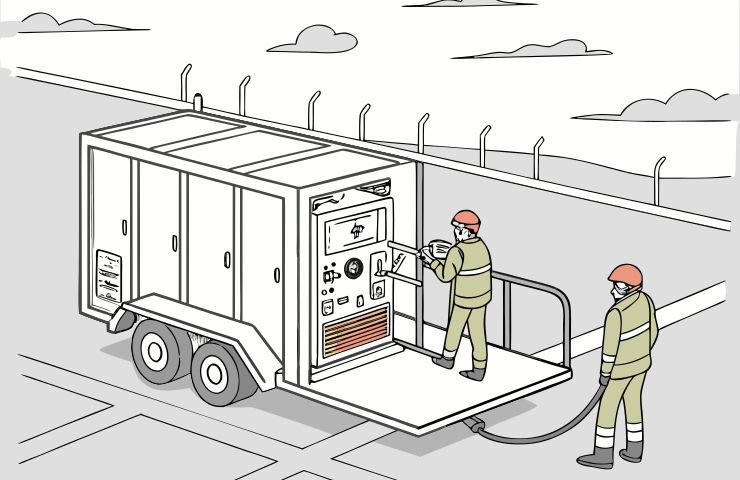
Ebara Elliott Energy has received an order from Chart Ferox to supply a specialized liquid-hydrogen pump system for integration into a mobile hydrogen refueling trailer. The order links to the Airbus-coordinated GOLIAT project on hydrogen infrastructure, and the completed trailer is slated for testing in Bristol, United Kingdom, while design validation work is carried out at Chart Ferox’s facility in the Czech Republic.
Project context
The GOLIAT initiative—Ground Operations of Liquid hydrogen Aircraft—aims to develop and demonstrate high-flow hydrogen handling and refueling systems for aviation ground operations. Launched in 2024 and supported by the European Union’s Horizon Europe programme with around €10.8 million in funding, it brings together academic, airport, and industry partners under the coordination of Airbus. Demonstrations of liquid-hydrogen ground operations are scheduled at airports such as Stuttgart, Rotterdam, and Lyon using a small test aircraft. The Chart Ferox trailer project in Bristol is reported separately and should not be confused with the three main airport demonstrations, although it is driven by the same ambitions to address the infrastructure gap for future hydrogen-fuelled aircraft.
The consortium behind GOLIAT includes technology providers such as H2FLY for aircraft integration, various airports for operational trials, and research institutions analysing certification and safety procedures. Over its planned four-year duration, the project will map out certification pathways, technical standards, and techno-economic assessments necessary before large-scale deployment. By focusing on mobile and fixed ground-support solutions, GOLIAT aims to bridge the gap between hydrogen production or liquefaction plants and commercial airports.
Ebara and Chart Ferox collaboration
Chart Ferox, based in Děčín, Czech Republic, is a specialist business within Chart Industries, which became an indirect subsidiary of Baker Hughes in July 2026. Chart Ferox’s expertise in cryogenic storage, transport, distribution, and refueling systems for liquefied gases underpins the design of the mobile refueling trailer. Ebara Elliott Energy, part of Japan’s Ebara Corporation in partnership with the historical Elliott Group, brings decades of experience in designing, manufacturing, and servicing compressors, steam turbines, and cryogenic pumps. Its liquid-hydrogen order represents an extension of its established rotating-equipment capabilities into aviation-specific hydrogen infrastructure.
Public materials confirm only that the order covers a liquid-hydrogen pump; the specific model, rated flow, pressure, efficiency, price, and delivery date were not disclosed. This level of confidentiality is common in early-stage demonstration projects where technical requirements and certification criteria are still under development.
Technical challenges
Handling liquid hydrogen at around –253 °C demands robust engineering to maintain cryogenic temperatures, manage boil-off gas, and prevent two-phase flow or cavitation. A liquid-hydrogen pump uses a centrifugal impeller—or in some cases a reciprocating mechanism—to boost pressure so the fuel can travel safely through insulated piping and a refueling coupling. Designers must minimize heat ingress, control vapor formation, protect seals and bearings against thermal stress, and integrate emergency shutdown and leak-detection systems. Refueling operations also involve purging air, chilling down lines, metering flow precisely, and capturing or venting boil-off to meet safety and operational requirements.
On the control side, integrated sensors, actuators, and custom software must coordinate pump speed, valve positions, and temperature monitoring in real time. Safety interlocks will automatically shut off flow at the first sign of anomaly, and operators must be trained to handle invisible hydrogen flames and cryogenic hazards such as frostbite and embrittled metal. These complexities drive the need for robust maintenance regimes, remote monitoring capabilities, and redundancy in critical components.
Historical and environmental context
Interest in liquid hydrogen as an aviation fuel spans decades. In the 1950s, NACA and the U.S. Air Force tested hydrogen propulsion on a modified B-57, and later experiments included the Soviet Tu-155 and Europe’s Cryoplane studies in the early 2000s. While those efforts proved technical feasibility, practical hurdles—such as large tank volume, infrastructure costs, and safety protocols—prevented commercial adoption. Modern projects shift focus to infrastructure demonstrations. A recent study in Environmental Science & Technology highlights that lifecycle emissions and contrails can offset hydrogen’s carbon-free combustion, underscoring the need for holistic evaluation of aviation’s climate impact.
Role of the pump and trailer
The pump supplied by Ebara Elliott Energy will be integrated into Chart Ferox’s mobile refueling trailer. Once delivered to Bristol, technicians will connect the trailer to a hydrogen supply—either carried onboard or fed from a local storage vessel—then purge lines, perform a chill-down, and run high-flow transfer tests. The mobile design allows Chart Ferox and project partners to trial ground operations across diverse airport environments without building permanent infrastructure. Data on pump reliability, flow rates, thermal performance, and safety responses will feed into standardisation and certification work for future larger-scale systems.
Regulatory and market considerations
Establishing safe procedures for liquid-hydrogen airport ground operations involves regulatory updates, revised emergency response plans, and new standardisation of mobile refueling equipment. Airports will need to adopt flame and gas detection, grounding protocols, and safety zones tailored to hydrogen’s invisibility in daylight and rapid diffusion. Transporting and operating mobile trailers requires compliance with cryogenic container regulations, pressure-vessel codes, and international standards such as ISO 21012 for hydrogen refueling interface compatibility. Airports will need to adopt revised insurance and liability frameworks to reflect hydrogen’s unique risk profile, potentially affecting offtake agreements and project financing for larger refuelling infrastructure.
Economic and supply-chain implications
The contract value and production volume were not disclosed, but such orders help Ebara Elliott Energy diversify beyond traditional oil, gas, and power sectors. For Chart Ferox, securing a dedicated pump supplier addresses a critical supply-chain gap for its refueling trailer programme. Manufacturing, installation, testing, and ongoing service work could support skilled jobs in Europe and Asia. While the immediate economic impact remains modest—given the pilot scale of GOLIAT—the order sets a precedent for suppliers and airport operators exploring hydrogen as a low-carbon fuel source in aviation.
Significance and outlook
The Ebara–Chart Ferox order is a concrete step in developing the supply chain and hydrogen infrastructure needed for aviation’s lower-carbon future. It doesn’t prove that liquid-hydrogen aircraft are commercially ready, but it does validate critical equipment and procedures. Successful testing could inform engineering standards, support further airport demonstrations, and signal confidence to other equipment suppliers. On the other hand, any delays, technical setbacks, or unresolved safety issues may slow the broader rollout. As we look ahead, data from the Bristol trials will be among the earliest real-world benchmarks for high-flow cryogenic refueling in civil airports.
In the coming months, Chart Ferox and Ebara will finalize delivery schedules and begin commissioning work in Bristol. The exercise will provide valuable insights into operational complexity, maintenance needs, and integration with airport systems—insights that are essential if hydrogen is to ever rival conventional jet fuel in global aviation.