Green Hydrogen Training: University of Lomé and Rostock Launch Double-Degree Master’s Programme
the University of Lomé and University of Rostock have signed an agreement to offer a double-degree Master’s in Bioenergy/Biofuels and Green Hydrogen Technology under the WASCAL-coordinated International Master’s Programme, aiming to strengthen regional expertise and student mobility across West Africa and Germany.
New Academic Partnership Formalised in Lomé
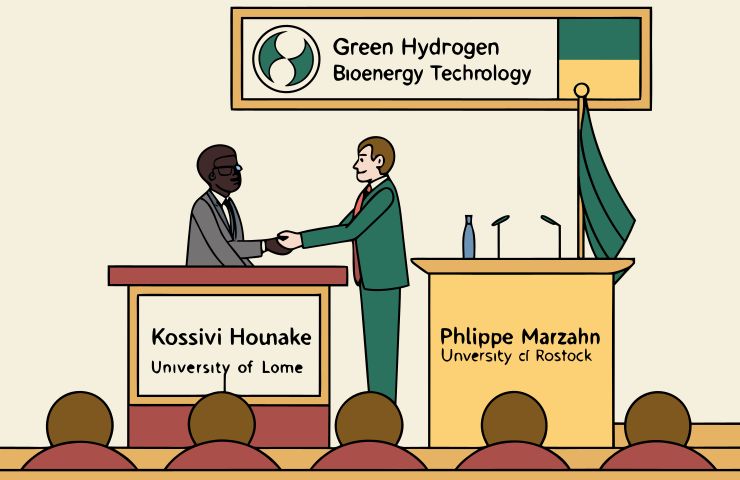
On 28 September 2026, the University of Lomé in Togo and the University of Rostock in Germany formalised a co-diplomation agreement to launch an international double-degree Master of Science pathway in energy and green hydrogen technology, multiple independent reports identify the signing date as 28 September 2026. The signing ceremony named Kossivi Hounaké, president of the University of Lomé, and Philippe Marzahn, dean of the Faculty for Agriculture, Civil and Environmental Engineering at the University of Rostock, as the signatories of the agreement. The accord is framed as a bilateral effort to deepen postgraduate training and research cooperation between West Africa and Germany.
Programme Structure and Specialisation
According to the West African Science Service Centre on Climate Change and Adapted Land Use (WASCAL) and the University of Rostock project page, the agreement embeds the Bioenergy/Biofuels and Green Hydrogen Technology track within the International Master’s Programme in Energy and Green Hydrogen Technology. It is a five-semester pathway that awards 120 ECTS credits. Students who meet the academic and administrative requirements qualify for Master of Science degrees from both institutions, WASCAL materials state. The curriculum links renewable-energy system integration with bioenergy, biofuels, energy-system analysis, photovoltaics, wind and hydropower, energy policy and electrolytic hydrogen production technology.
Regional Host and Laboratory Infrastructure
In Lomé, the University of Lomé serves as the West African host institution for this specialisation and provides core training facilities, including a dedicated biogas laboratory, according to WASCAL programme information. The biogas lab supports research on anaerobic digestion processes that convert agricultural residues and organic waste into methane-rich biogas, WASCAL notes, reinforcing the link between biomass valorisation and hydrogen-based value chains in emerging markets. Practical coursework and laboratory access are positioned as central to the track’s regional mandate.
German Coordination and Mobility
The University of Rostock’s Faculty for Agriculture, Civil and Environmental Engineering coordinates and scientifically manages the track, the university reports, contributing teaching and hosting students in Germany for one semester. University of Rostock staff also supervise master’s theses and facilitate industrial collaboration and scientific dissemination, the project page states. Designed mobility between Lomé, Niger and Rostock aims to broaden practical skills and cross-cultural research experience for enrolled students.
Programme Classification and Operational Details
The programme is classified as level 7 under the European Qualifications Framework, multiple reports state. Operational details such as the first intake date, cohort size, tuition fees and scholarship allocations were not disclosed in the signing release. Administrators say those items remain subject to further institutional decisions and any external funding schedules that will determine the programme’s initial scale.
Technical Dive: Green Hydrogen and Electrolysers
Green hydrogen production relies on electrolysis, a process that splits water into hydrogen and oxygen using electricity from renewable sources such as solar, wind or hydropower, according to IRENA. Electrolysers, which come in alkaline and proton-exchange-membrane families, drive this reaction by feeding direct current into electrochemical cells where an electrolyte or membrane carries ions between electrodes. The generated hydrogen is then purified, dried, compressed and stored for industrial processes, energy storage or later conversion into chemicals and fuels. The programme’s technical modules are built around these operative steps and the practical challenges of integrating electrolysers into variable renewable grids.
Complementary Bioenergy Technologies
In parallel, bioenergy and biofuel systems convert biomass into heat, electricity or liquid fuels. WASCAL programme information highlights anaerobic digestion as a key method, where organic feedstocks are broken down in oxygen-limited reactors to produce biogas mainly composed of methane and carbon dioxide. After cleaning and upgrading, biomethane can feed power generation or serve as a flexible renewable feedstock that complements hydrogen pathways in integrated energy systems. The course material, according to the programme notes, emphasizes the interfaces between biomass valorisation and hydrogen production chains.
Integration within Renewable-Energy Systems
Effective energy-system integration matches variable renewable generation with demand via forecasting, grid controls, flexible loads, battery storage or hydrogen production, according to WASCAL and IRENA. An electrolyser can act as a flexible electricity consumer when renewable power is abundant, while stored hydrogen provides seasonal or industrial use. This approach requires transmission capacity, stable regulation and safety standards to enable hydrogen refuelling stations, industrial decarbonisation and cross-border energy trade. Teaching modules are said to cover those system-level requirements alongside operational best practices.
Addressing Skills Gaps in West Africa
Togo remains partly dependent on power imports: domestic generation supplied 53.3 percent of electricity injected into the national grid in 2024, while imports accounted for 46.7 percent, according to data from the Togolese Ministry of Energy. By training engineers, researchers and policy analysts in renewable energy, hydrogen production and system integration, the programme aims to close regional expertise gaps that currently constrain industrial decarbonisation and infrastructure development, the agreement indicates. Closing those gaps is framed as essential to advance both national and regional energy transitions.
WASCAL’s Regional Capacity-Building Role
The West African Science Service Centre on Climate Change and Adapted Land Use (WASCAL) established the International Master’s Programme in Energy and Green Hydrogen Technology in 2021 to bolster climate-relevant research and education, WASCAL materials state. The broader initiative offers six tracks across West Africa and Germany and is open to students from ECOWAS countries. WASCAL notes that five tracks secured ASIIN accreditation in 2025, while the Lomé–Rostock track was still undergoing accreditation as of October 2026.
Project Timeline and Funding
The International Master’s Programme operates under the IMP-EGH initiative, which University of Rostock materials indicate runs from October 2023 to March 2028. Funding comes from the German Federal Ministry of Research, Technology and Space, supporting institutional capacity building, postgraduate education and research infrastructure across participating universities, the project page states. The multi-year schedule is intended to provide a window for monitoring graduate outcomes and early research outputs.
Historical Context and Institutional Linkages
The University of Lomé traces its origins to 1970 when it was founded as the University of Benin and was renamed in 2001, according to the university’s research presentation. The University of Rostock, established in 1419, is the oldest institution in the Baltic Sea region, the university reports. Cooperation between Lomé and Rostock began in 2023, building on Germany-funded partnerships aimed at strengthening postgraduate education, research infrastructure and international mobility in energy fields. Per the University of Lomé research presentation, the university serves Togo as a public institution responsible for higher education, scientific research, innovation and professional training, with a dual mission of teaching and research. The co-diplomation agreement is intended to strengthen postgraduate training, research cooperation and mobility in energy-related fields between Europe and West Africa.
Opportunities, Risks and Forward Look
Industry observers say academic partnerships like this can underpin future hydrogen and renewable-energy projects by supplying qualified personnel, designing regulatory frameworks and certifying safety standards. However, IRENA cautions that water planning and lifecycle analysis are vital to avoid unintended environmental impacts. UNDP warns that without effective governance, green-hydrogen deployment risks intensifying pressure on land, water and critical minerals. The agreement represents a capacity-building milestone whose ultimate impact hinges on transparent admissions, sustainable financing, complete accreditation, accessible labs and graduate employability in public agencies and industry, the parties state. According to University of Rostock materials, the IMP-EGH initiative’s multi-year framework will run until March 2028, providing time to evaluate graduate outcomes and research outputs in support of West African energy transitions.