Hydrogen news
Wilo's Leap into Green Hydrogen Transition with H2Powerplant
This move arrives at a time in which only 1 percent of current H2 production is carbon emission free. Wilo is moving forward in a strategy to ensure that it keeps on top of the clean energy wave pushing toward the use of green hydrogen as the world decarbonizes. It is doing so with a unique operating plant to harness H2 with its H2Powerplant. The company is calling the strategy a world-first in a live production environment. Wilo’s world’s first to market H2Powerplant is intended as a green hydrogen solution that proves the concept of decentralized power generation and energy independence. Th…
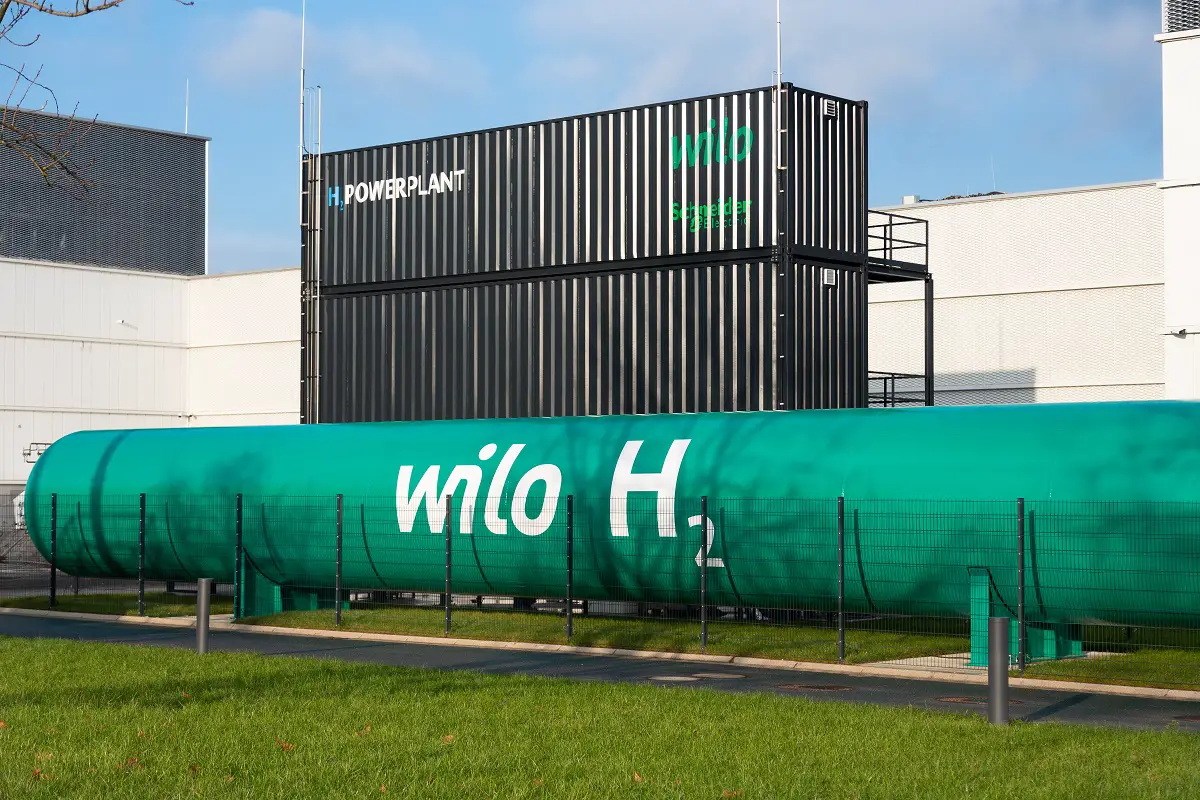
This move arrives at a time in which only 1 percent of current H2 production is carbon emission free.
Wilo is moving forward in a strategy to ensure that it keeps on top of the clean energy wave pushing toward the use of green hydrogen as the world decarbonizes. It is doing so with a unique operating plant to harness H2 with its H2Powerplant.The company is calling the strategy a world-first in a live production environment.
Wilo’s world’s first to market H2Powerplant is intended as a green hydrogen solution that proves the concept of decentralized power generation and energy independence. The plant is already operational at the company’s Wilopark headquarters in Dortmund, Germany. It represents a new angle for renewable H2 production. [caption id="attachment_59526" align="aligncenter" width="400"] New Green Jobs Posted Daily[/caption]
This could prove to be a meaningful strategy as IRENA currently estimates that only 1 percent of the current H2 production worldwide is greenhouse gas emission free.
https://youtu.be/yJkOXtrABgk
Now that Wilo’s concept has been proven through operation, the company intends to roll it out across all its locations while also making it available to the market in a modular format to meet a range of energy demands. It will be available for purchase in four different sizes. These will meet the energy needs equivalent to three, five, or twenty households.
New Green Jobs Posted Daily[/caption]
This could prove to be a meaningful strategy as IRENA currently estimates that only 1 percent of the current H2 production worldwide is greenhouse gas emission free.
https://youtu.be/yJkOXtrABgk
Now that Wilo’s concept has been proven through operation, the company intends to roll it out across all its locations while also making it available to the market in a modular format to meet a range of energy demands. It will be available for purchase in four different sizes. These will meet the energy needs equivalent to three, five, or twenty households.
The green hydrogen system uses renewable electricity to power electrolysis to produce the H2.
The renewable energy will be sourced from solar, wind and/or hydropower. The H2 produced can then be used in a fuel cell in order to convert the H2 into electrical energy. The only emissions produced are heat and water vapor, meaning that greenhouse gases such as carbon dioxide are avoided. Moreover, the waste heat can also be used within an interconnected system, providing heating, or it can be stored or converted into cooling on site.
A solution that can retrofit applications
The energy system can also be used in conjunction with new or existing combined heat and power (CHP) systems to provide additional support if they were designed to function with a blended hydrogen gas. As a result this green hydrogen solution can also be applied to retrofit applications, according to the company.
Hydrogen FAQ's About New Green Hydrogen Solution
Q1: What is green hydrogen? A: Green hydrogen is a type of hydrogen that is produced through electrolysis powered by renewable energy sources such as solar, wind, or hydropower. The production process results in zero emissions, making it an environmentally-friendly alternative to traditional hydrogen production methods. Q2: What is the H2Powerplant? A: The H2Powerplant is a groundbreaking green hydrogen solution developed by Wilo. It represents a new approach to decentralized power generation and energy independence. The plant utilizes renewable electricity to power electrolysis, producing green hydrogen which can then be used in a fuel cell to generate electrical energy. Q3: Where is the H2Powerplant based? A: The H2Powerplant is currently operational at Wilo's Wilopark headquarters in Dortmund, Germany. Q4: How much of the current H2 production is greenhouse gas emission free? A: According to estimates from the International Renewable Energy Agency (IRENA), only 1 percent of current H2 production worldwide is greenhouse gas emission free. Q5: How will the H2Powerplant be made available to the market? A: Wilo plans to roll out the H2Powerplant across all its locations and make it available to the market in a modular format. This means it can be tailored to meet a range of energy demands. The plant will be available for purchase in four different sizes, catering to the energy needs equivalent to three, five, or twenty households. Q6: What are the emissions produced by the H2Powerplant? A: The only by-products of the H2Powerplant are heat and water vapor, meaning greenhouse gases such as carbon dioxide are avoided. The waste heat can also be utilized within an interconnected system for heating, or it can be stored or converted into cooling on-site. Q7: Can the H2Powerplant be used in retrofit applications? A: Yes, the green hydrogen solution provided by the H2Powerplant can be applied to retrofit applications. It can also be used in conjunction with new or existing combined heat and power (CHP) systems to provide additional support if they were designed to function with a blended hydrogen gas.How was this article?
Thanks for the feedback!