FuelCell Energy Block System Secures 99.873% ELCC Accreditation in PJM Capacity Process
FuelCell Energy’s Block System earned a 99.873% ELCC accreditation in PJM’s 2028/2029 Reliability Backstop Procurement process, indicating nearly 99.9 MW per 100 MW can qualify as accredited capacity for data-center power under PJM rules.
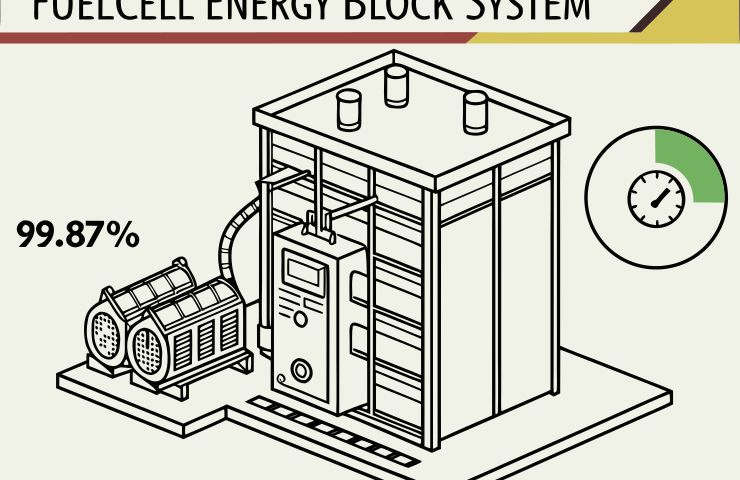
FuelCell Energy said its planned Block System earned a 99.873% unit-specific accreditation under Effective Load Carrying Capability in PJM Interconnection’s 2028/2029 Reliability Backstop Procurement process. The result, disclosed this month, implies that nearly 99.9 MW of every 100 MW evaluated could be counted as dependable capacity under PJM’s capacity-market rules, subject to interconnection rights and final procurement outcomes. Interest in hydrogen fuel cell and distributed energy solutions is rising in regional reliability planning, and FuelCell Energy’s announcement sits squarely in that context.
Key Insights
- ELCC accreditation measures a resource’s reliability contribution in PJM’s capacity market, rather than its uptime or forced-outage rate.
- System-specific factor applies only to the Block System evaluated for the 2028/2029 process, not to FuelCell Energy’s entire platform.
- Dependent capacity interpretation indicates 99.873 MW of 100 MW could qualify as accredited unforced capacity (UCAP).
- Data-center demand is driving roughly 30 GW of an expected 32 GW peak-load increase by 2030 in PJM’s footprint.
- Modular design uses 1.25 MW, 2.5 MW and 12.5 MW units that can be added incrementally to match growth.
- Combustion-free stack yields low NOx and SOx emissions, though overall CO₂ output depends on fuel choice.
- Preliminary comparisons cited by FuelCell Energy include ELCC factors of 96% for nuclear and 67% for combustion turbines.
- Conditional outcome accreditation does not guarantee procurement awards, financing or long-term revenue.
Historical Perspective
Stationary fuel-cell research dates back to the 1960s. FuelCell Energy traces its roots to Energy Research Corporation, founded in 1969, and the company began commercial sales of megawatt-scale plants in 2003. Early demonstrations included a 2 MW carbonate fuel-cell installation in California. Since those initial projects, FuelCell Energy has broadened its portfolio to encompass carbonate and solid-oxide platforms aimed at on-site power, carbon capture and hydrogen production. At the same time, PJM Interconnection has revised how it credits capacity — moving from installed-capacity and forced-outage metrics to ELCC in the 2025/2026 delivery year to better accommodate variable renewables and storage.
Context: PJM’s Data-Center Reliability Challenge
PJM runs the grid across parts of 13 states and Washington, D.C., and must balance generation and transmission in a market with a wide array of resource types. Publicly available forecasts indicate the region may need an additional 32 GW of capacity by 2030, with data centers accounting for almost all of that new demand. These large-scale computing facilities require uninterrupted power and tight voltage regulation. The consequence has been pressure on interconnection queues and existing infrastructure. Regulators and utilities are therefore exploring frameworks to connect data centers without undermining affordability or system reliability.
Conventional options—batteries, diesel engines or combustion turbines—carry limits on runtime, permitting complexity or emissions. As a result, dispatchable on-site systems such as fuel cells are attracting attention for their ability to be deployed relatively quickly and to provide continuous output.
FuelCell Energy’s Carbonate Fuel-Cell Platform
According to FuelCell Energy, its Block System is built around a high-temperature molten carbonate electrolyte that conducts carbonate ions through porous electrodes. At operating temperatures exceeding 600 °C, methane-based fuels can be reformed internally into a hydrogen-rich stream. Electrochemical reactions at the anode and cathode release electrons, producing direct current that power electronics convert to alternating current. The process also yields high-grade heat suitable for cogeneration. Because the chemistry avoids combustion at the cell stack, NOx and SOx emissions are low compared with conventional generators. The platform is designed for continuous operation on natural gas, biogas or hydrogen blends and FuelCell Energy now markets Block System modules in 1.25 MW, 2.5 MW and 12.5 MW configurations, deployable in arrays for scalability and redundancy.
Capacity Accreditation Explained
PJM Manual 21B defines Effective Load Carrying Capability (ELCC) as a probabilistic model that calculates how much of a resource’s installed capacity contributes to grid reliability. Accredited unforced capacity (UCAP) equals a resource’s nameplate rating multiplied by its ELCC factor, adjusted for performance metrics and interconnection rights. PJM supplies generic class ratings for resource categories, but the rules permit resource-specific ELCC values when those better reflect actual performance. Thus the 99.873% figure represents the fraction of installed capacity accredited for market purposes rather than a literal measure of physical availability.
Under those rules, a 100 MW Block System could offer 99.873 MW of UCAP in capacity auctions. That accredited capacity shapes potential market participation and revenue but does not guarantee auction awards or fixed payments. PJM’s independent market monitor noted that ELCC adoption enhances risk modeling as more variable renewables and storage join the capacity mix.
Comparisons with Other Resource Classes
In its announcement, FuelCell Energy reported preliminary ELCC comparisons across resource classes. Cited values included around 96% for nuclear power, 93% for diesel-engine backup systems and 67% for gas combustion turbines. These figures are specific to the 2028/2029 RBP process and have not been independently verified, but they illustrate how resource types diverge under PJM’s methodology.
Strategic Implications for Distributed Generation
- Project finance: High UCAP accreditation can strengthen debt and equity structures by signaling capacity revenue potential under PJM rules.
- Competitive landscape: Fuel cells now compete with gas turbines, engines, batteries and grid upgrades for data-center energy contracts.
- Operational resilience: Local generation reduces reliance on transmission, mitigating outage risks for mission-critical loads.
- Regulatory advantages: Combustion-free stacks may simplify local air permitting compared to combustion generators.
- Siting considerations: Fuel supply logistics, including pipeline access or biogas handling, influence project timelines and costs.
- Lifecycle costs: While capital expenses are significant, continuous operation and combined heat recovery can improve total cost of ownership.
Analyst Outlook
As hyperscale and enterprise data centers keep expanding, accredited capacity under ELCC will become a central input to project economics and reliability planning. Analysts expect resource-specific ELCC values to intensify technology competition and to influence investment decisions. FuelCell Energy’s high-accreditation result positions carbonate fuel cells as strong contenders. That said, future RBP cycles may incorporate updated outage data, revised generic class ratings and shifting interconnection policies. Decarbonization goals and potential hydrogen blending could also shape long-term emissions profiles and capacity metrics.
Looking Ahead
The 99.873% accreditation for FuelCell Energy’s Block System highlights the potential role of fuel cells within PJM’s capacity framework. Real-world deployment, however, depends on securing interconnection rights, completing commissioning and finalizing fuel agreements. PJM’s capacity procurement rules and ELCC assumptions are subject to periodic review, and upcoming Reliability Backstop cycles may feature different parameters. For operators weighing on-site power options, UCAP accreditation will be a key consideration — yet operational, regulatory and financial factors will ultimately determine project viability.