Hydrogen news
Eco-Runner hydrogen car sets new Guinness World Record
Student team from TU Delft has set a distance record with their H2 city car concept. The hydrogen car Eco-Runner Team Delft that was presented in May by a student team, has set a Guinness World Record for distance, with the concept car driving the greatest distance on full tanks of hydrogen fuel. The record was set on June 26 at the Immedingen test track in Germany. The team, which consists of 24 students, built a vehicle that was more robust than last year’s model. This latest model is lighter and was given a refined aero shape. Construction began in February and the prototype was presented…
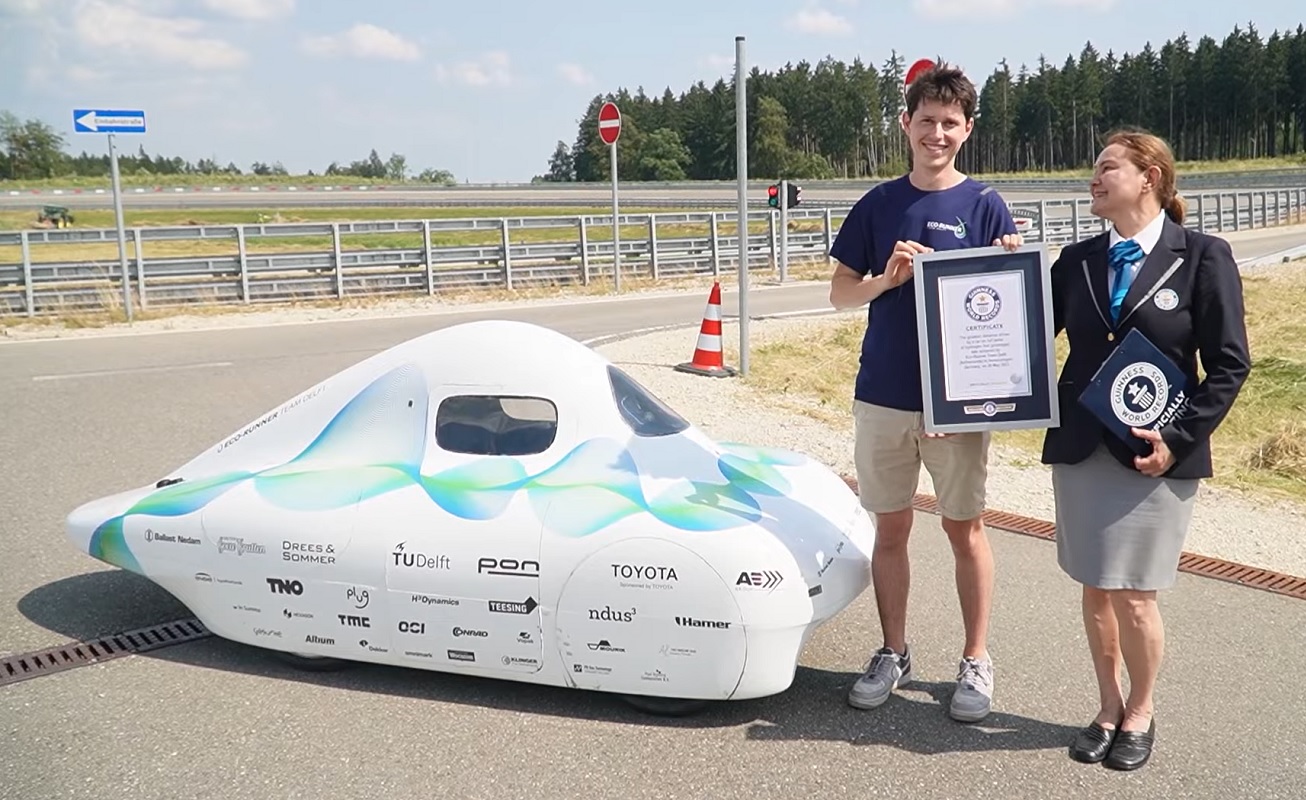
Student team from TU Delft has set a distance record with their H2 city car concept.
The hydrogen car Eco-Runner Team Delft that was presented in May by a student team, has set a Guinness World Record for distance, with the concept car driving the greatest distance on full tanks of hydrogen fuel.The record was set on June 26 at the Immedingen test track in Germany.
The team, which consists of 24 students, built a vehicle that was more robust than last year’s model. This latest model is lighter and was given a refined aero shape. Construction began in February and the prototype was presented in May as the Eco-Runner XIII. [caption id="attachment_59466" align="aligncenter" width="1664"] Advertisement[/caption]
The students headed to the Immendingen test track for the record attempt in June. The hydrogen car began its circuit on June 23 and traveled 45 km/h (28 mph) during the run, nearly doubling the speed of its predecessor.
The previous record of 2,056 km (1,277.53 miles) was broken on June 26, when the hydrogen-powered vehicle finally came to a stop at 8:26 am. In total it traveled 2,488.45 km (1,546.18 miles) on 950 g of hydrogen, setting the new Guinness World Record for “the greatest distance driven by a car on full tanks of hydrogen fuel (prototype).”
https://www.youtube.com/watch?v=cFkCRGbllFU&t=10s
Advertisement[/caption]
The students headed to the Immendingen test track for the record attempt in June. The hydrogen car began its circuit on June 23 and traveled 45 km/h (28 mph) during the run, nearly doubling the speed of its predecessor.
The previous record of 2,056 km (1,277.53 miles) was broken on June 26, when the hydrogen-powered vehicle finally came to a stop at 8:26 am. In total it traveled 2,488.45 km (1,546.18 miles) on 950 g of hydrogen, setting the new Guinness World Record for “the greatest distance driven by a car on full tanks of hydrogen fuel (prototype).”
https://www.youtube.com/watch?v=cFkCRGbllFU&t=10s
A new hydrogen car concept is designed every year.
The Eco-Runner project began in 2005, with the three-wheeled Eco 1, which placed in the top five at the 2006 Shell Eco-marathon. The project has continued with a new car ever since. However, it wasn’t until the second vehicle that the team used hydrogen as a fuel source. [caption id="attachment_59500" align="aligncenter" width="1314"]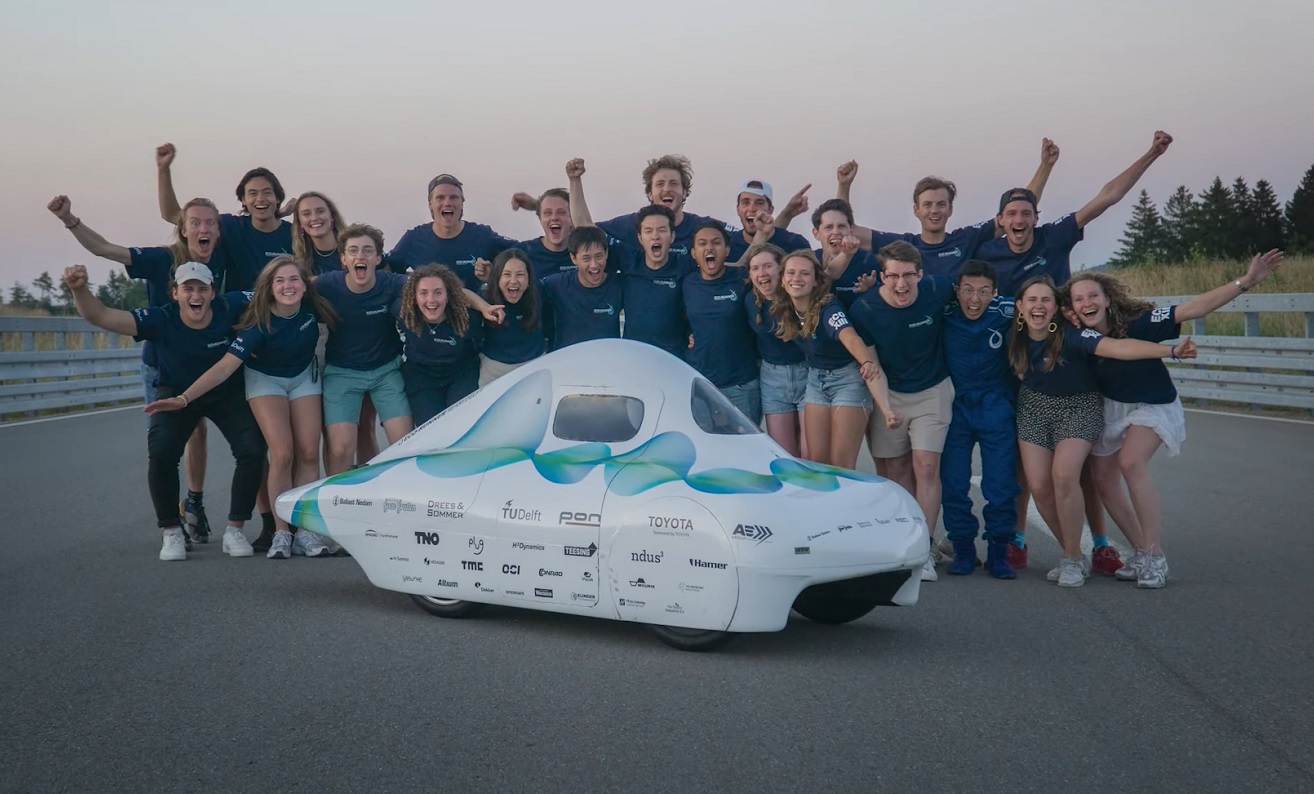 Eco-Runner Team Delft with Eco-Runner XIII[/caption]
This second bullet-shaped prototype routed H2 from a storage tank to a fuel cell to generate an electrochemical reaction which produced an electric current. The vehicle emitted only water vapor.
Each year, the design of the vehicle evolved, and in 2020, the first urban class concept was produced. The vehicle still had three wheels, but its length was significantly reduced. The following year, a fourth wheel was added to the hydrogen car concept, and it managed to travel a distance of 1,195.74 km (742.99 miles), driving 36 hours non-stop on a tank of hydrogen.
Eco-Runner Team Delft with Eco-Runner XIII[/caption]
This second bullet-shaped prototype routed H2 from a storage tank to a fuel cell to generate an electrochemical reaction which produced an electric current. The vehicle emitted only water vapor.
Each year, the design of the vehicle evolved, and in 2020, the first urban class concept was produced. The vehicle still had three wheels, but its length was significantly reduced. The following year, a fourth wheel was added to the hydrogen car concept, and it managed to travel a distance of 1,195.74 km (742.99 miles), driving 36 hours non-stop on a tank of hydrogen.
A new team a new target
The Eco-Runner project is an annual collaboration of students across different faculties. Each year, a new team comes together to focus on making the newest prototype better than the last. The 2022 Eco-Runner prototype took first place in the Hydrogen Efficiency Challenge and this year’s prototype, which was designed to be over 100 times more fuel-efficient than modern fossil fuel cars, secured a new distance record. As the Eco-Runner hydrogen car project continues, it will be interesting to see what the next team will build as it attempts to beat this latest achievement.
Hydrogen FAQ's For This Article:
1. What is the Eco-Runner Team Delft? The Eco-Runner Team Delft is a group of 24 students who have designed and built a hydrogen-powered concept car. The team and their vehicle, Eco-Runner XIII, recently set a Guinness World Record for the greatest distance driven on full tanks of hydrogen fuel. 2. What record did the Eco-Runner XIII set? The Eco-Runner XIII set a new Guinness World Record for "the greatest distance driven by a car on full tanks of hydrogen fuel (prototype)." On June 26, the vehicle traveled 2,488.45 km (1,546.18 miles) on 950 g of hydrogen. 3. How does the Eco-Runner project work? The Eco-Runner project started in 2005 and involves designing a new hydrogen car concept each year. A new team of students across different faculties comes together annually to improve upon the previous prototype. 4. What improvements have been made over the years? Each year, the design of the vehicle evolves. In 2020, the first urban class concept was produced with significant reduction in length and the vehicle still had three wheels. The following year, a fourth wheel was added to the hydrogen car concept, allowing it to travel a distance of 1,195.74 km (742.99 miles) non-stop on a tank of hydrogen. 5. What was the achievement of the 2022 Eco-Runner prototype? The 2022 Eco-Runner prototype won first place in the Hydrogen Efficiency Challenge and set a new distance record. It was designed to be over 100 times more fuel-efficient than modern fossil fuel cars. 6. What is the fuel source for the Eco-Runner vehicles? Starting from the second vehicle, the Eco-Runner team has used hydrogen as a fuel source. The hydrogen is routed from a storage tank to a fuel cell, generating an electrochemical reaction that produces an electric current. The only emission from the vehicle is water vapor. Ready to test your knowledge on the most abundant element in the universe? Take our fun and engaging Hydrogen Quiz now! [forminator_quiz id="58712"]How was this article?
Thanks for the feedback!