Green Hydrogen Production Costs Could Nearly Double Under Round-the-Clock Off-Grid Supply, Fraunhofer ISE Analysis Finds
Fraunhofer ISE finds that round-the-clock green hydrogen delivery from off-grid renewables can increase LCOH by €1–2.5/kg and in some regions nearly double costs, highlighting the infrastructure trade-off between reliability and competitiveness.
The Fraunhofer Institute for Solar Energy Systems ISE has taken a close look at how delivering green hydrogen around the clock from off-grid solar and wind projects stacks up economically. Their findings suggest that when you require a steady flow of hydrogen, it means oversizing the renewable energy capacity and investing in sizable hydrogen storage. This, in turn, hikes up the levelized cost of green hydrogen production (LCOH) by about €1–2.5 per kilogram in pretty common scenarios. For areas with fewer resources, that penalty can nearly double the overall LCOH compared to a more flexible, intermittent supply approach.
As shared by Hydrogen Insight, researcher Marius Holst brought this information to light, pointing out a serious shortcoming in many renewable fuels of non-biological origin (RFNBO) rules and industrial contracts. If green hydrogen is treated like a stable gas commodity without considering the costs tied to reliability across the board, it can turn what should be promising decarbonization efforts into not-so-competitive projects.
Diving Into the Modeling Approach
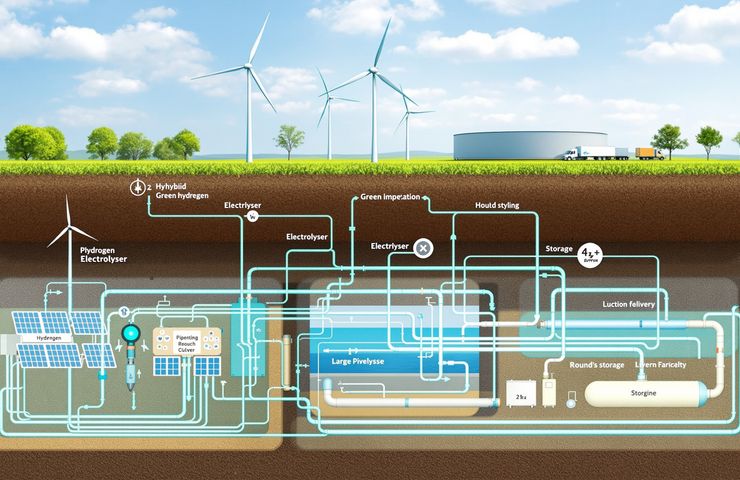
So, how did they get there? The team at Fraunhofer ISE developed techno-economic supply chain models focusing on how firm delivery requirements impact off-grid electrolysis systems. In their simulations, they paired solar photovoltaic (PV) arrays and wind turbines with either proton exchange membrane (PEM) or alkaline electrolyzers to boost renewable hydrogen production. Without storage, hydrogen output aligns with the variability of renewable energy—peaking when the sun’s shining or the wind’s blowing, and dropping off completely during calmer periods. To replicate round-the-clock contracts, the model introduced hydrogen-capable underground storage and oversized both the renewable components and electrolyzers until they maintained a consistent mass flow, no matter the real-time generation.
In terms of capital costs, these scenarios factor in the renewable assets, electrolyzer stacks, balance-of-plant expenses, and hydrogen infrastructure, including underground storage sized to handle days or weeks of variability. Operating expenses cover upkeep, water needs (about 9–12 liters of freshwater per kilogram of H₂), and energy for storage cycling. The LCOH is calculated by discounting total lifetime costs and dividing that by annual hydrogen output. Unfortunately, the costs related to storage and oversizing balloon faster than the production increases, driving up the €/kg prices.
Main Findings: Cost Penalties and Regional Differences
In areas rich in resources, imposing that constant-supply constraint bumps the LCOH up by around €1–2.5/kg. However, in regions with low average renewable capacity—think standalone PV sites up north—the oversizing and storage needs can push that extra cost above €10/kg, effectively doubling the LCOH compared to a flexible setup. These findings match broader studies on reliable green hydrogen supply, with a Royal Society of Chemistry analysis putting reliable supply costs at around USD 18–22/kg, versus just USD 4–6/kg for flexible production, hinting that we could achieve future reliable supply costs of USD 8–10/kg as technologies get better.
Similarly, Fraunhofer’s Cluster of Excellence CINES reached conclusions that echo these thoughts in their study of German applications. For grid-connected peak-load power plants in 2035, CINES estimates delivered hydrogen costs will hover between €8.77 and €15.16/kg, with about half of that cost tied to transport and storage. On the flip side, industrial base-load consumers—who need hydrogen continuously—will see procurement costs ranging from €4.41 to €8.43/kg, with infrastructure costs only making up about 16% of the total thanks to higher asset utilization.
Strategic Insights for Contracts and Policy
What's interesting is that offtakers and policymakers often assume green hydrogen can be delivered in a steady, uninterrupted flow like natural gas. But Fraunhofer’s research shows how crucial it is to have well-thought-out contract structures. Going for flexible hydrogen purchasing agreements allows industrial processes to time their hydrogen consumption to match renewable energy availability, which helps dodge most storage costs and brings LCOH in line with production metrics. On the other hand, sticking to rigid 24/7 delivery requirements will likely need greater subsidy support or carbon pricing to reconcile the cost gap with traditional grey hydrogen.
This has direct implications for European RFNBO regulations and hydrogen offtake mandates affecting steel, ammonia, and refineries. If regulations insist on tight timing between renewable energy generation and hydrogen output, project developers might find themselves needing to negotiate larger contract premiums or government backing. Alternatively, regulators could explore allowing for temporal pooling or mechanisms for grid balancing to lessen storage demands and lower the LCOH for off-grid green hydrogen initiatives.
Making Comparisons and Context
While many global projections suggest that green hydrogen costs could drop below USD 2–2.5/kg in resource-rich areas by 2030, those estimates often assume high utilization rates and overlook the need for large-scale buffering. In contrast, research on long-duration energy storage has shown that geological options, like salt caverns, can offer levelized costs around €0.2–0.5/kg, though they’re limited geographically. Fraunhofer’s insights tie these aspects together, demonstrating that storage is a significant cost factor for reliable supply and that picking the right locations is crucial for project economics.
Other studies have looked into hybrid setups, combining off-grid renewables, limited grid imports, and flexible electrolyzer operations to decrease the need for storage and secure more competitive LCOH. Early pilots in Spain and Australia have shown that grid-connected electrolysis can serve as a buffer, swapping between grid power and behind-the-meter renewables to balance supply while keeping dedicated storage volumes to a minimum.
Looking Ahead: Infrastructure and Market Implications
The findings from Fraunhofer ISE may just change the game for how investors and lenders assess hydrogen infrastructure projects. Financial models will have to be more explicit about storage capital and usage rates. Off-grid green hydrogen projects lacking flexible offtake options might find it tough to secure financing unless they show solid credit support or take advantage of favorable regulatory conditions. Meanwhile, clustered industrial parks with varied demand could share hydrogen storage and distribution assets, driving down per-kilogram infrastructure costs through economies of scale.
On the tech side, this study really highlights the pressing need for more budget-friendly storage solutions—like advanced materials for high-pressure vessels, modular underground pipelines, and innovative chemical carriers. Electrolyzer manufacturers might also prioritize enhancing partial-load efficiency so their systems can adjust smoothly during lower renewable output, cutting down on storage requirements.
A Final Thought
Fraunhofer ISE's research is a crucial reminder to the hydrogen community that reliability comes with a price tag. As our industries race to decarbonize and as policymakers sketch out hydrogen roadmaps, understanding the full system costs tied to firm off-grid supply is essential. By embracing flexible consumption models, hybrid grid links, and strategically locating projects in high-resource regions, we can keep the economic dream of green hydrogen alive. If we ignore these adjustments, we risk complicating the vision of replicating natural gas-like delivery and undermining the potential of truly renewable molecules in our global energy landscape.