Fuel Cell Catalyst Durability Enhanced by Nitrogen-Doped Graphene Shells on Pt@N-FLG/SWCNT
Nagoya University reports that its Pt@N-FLG/SWCNT catalyst retains 96.9% of its electrochemical surface area after 30,000 accelerated cycles, boosting fuel cell durability.
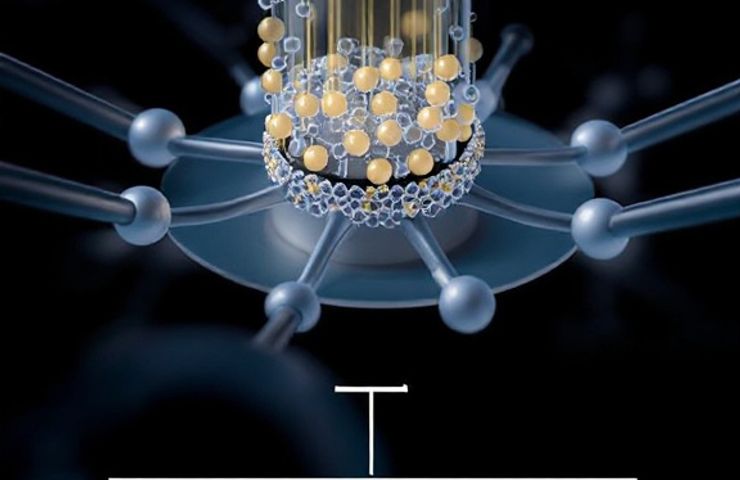
Researchers at Nagoya University report a new cathode catalyst architecture for polymer-electrolyte fuel cells. Their approach encapsulates platinum nanoparticles in layered nitrogen-doped graphene and bonds those particles to single-walled carbon nanotubes, Nagoya University says.
The composite material, named Pt@N-FLG/SWCNT, produced an electrochemical surface area of 96.3 m² per gram of platinum and a mass activity of 369 mA mg⁻¹ at 0.9 V versus the reversible hydrogen electrode in laboratory tests, according to a peer-reviewed paper in ACS Catalysis. Those metrics exceeded the performance of a commercial Pt/C reference used in the same experiments, the paper shows.
Membrane-electrode assembly testing under accelerated durability cycles — designed to mimic repeated start–stop events and periods of high-power operation — found that the catalyst retained 96.9 percent of its electrochemical surface area after 30,000 cycles between 0.6 and 0.95 V, Nagoya University reports. Over that run the material experienced a voltage loss of 22.8 mV at a current density of 0.8 A cm⁻². In a separate high-voltage protocol between 1.0 and 1.5 V, intended to stress carbon supports, the material lost 27.2 percent of its active surface after 5,000 cycles and showed no observed voltage drop at 1.5 A cm⁻², according to Nagoya University. The university notes these figures are superior to those measured for the commercial Pt/C reference under the same conditions.
Technology Overview
The Pt@N-FLG/SWCNT catalyst integrates three core design elements: nanoscale platinum, a protective few-layer graphene shell doped with nitrogen, and a single-walled carbon nanotube support. Platinum nanoparticles supply the active sites for the cathode’s oxygen-reduction reaction, a slow but essential step in hydrogen fuel cell operation. Traditional catalysts place platinum on amorphous carbon, which can corrode; the metal can also sinter or migrate when the cell is subjected to dynamic loads.
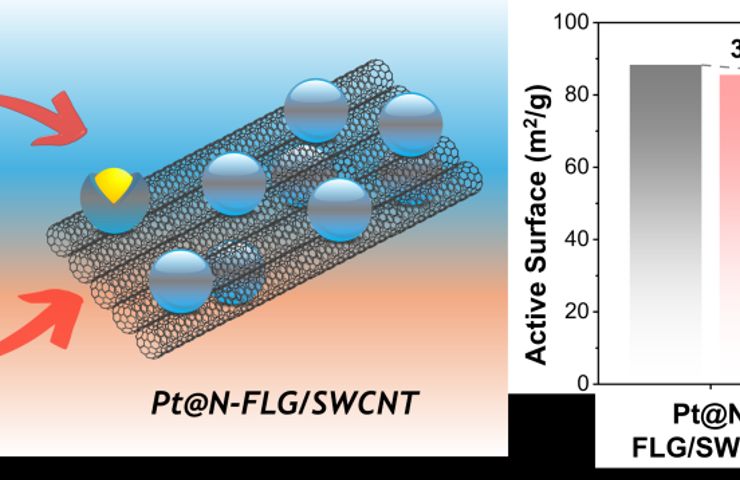
Here, each platinum particle is encased in a nitrogen-doped graphene shell that physically limits migration and coalescence while also interacting electronically with the metal. Nitrogen atoms in the graphene lattice alter the local electron density at the platinum surface; that adjustment aims to preserve or improve catalytic activity without blocking reactant access. Meanwhile, the single-walled carbon nanotube (SWCNT) network functions as a highly conductive, chemically resilient scaffold designed to better resist corrosion during start–stop cycles and high-potential excursions.
Transmission electron microscopy images taken after durability testing show slender, wire-like platinum structures anchored to the nanotube support rather than large agglomerates, Nagoya University notes. By keeping a high electrochemical surface area, the architecture addresses both the kinetic needs for oxygen reduction and the long-term stability required by heavy-duty transport and stationary power applications.
Durability Testing and Benchmarks
Accelerated durability protocols were used to reproduce common degradation modes within a laboratory time frame. Cycling between 0.6 and 0.95 V stresses platinum stability at typical cathode potentials; cycling up to 1.5 V accelerates carbon corrosion. After 30,000 low-voltage cycles the catalyst lost just 3.1 percent of its surface area, corresponding to a 96.9 percent retention, Nagoya University reports. The voltage at 0.8 A cm⁻² declined by 22.8 mV over that series.
In the corrosion-focused test that ran between 1.0 and 1.5 V for 5,000 cycles, the electrochemical surface area fell by 27.2 percent but no voltage loss was detected at 1.5 A cm⁻², according to Nagoya University. The group adds that these results exceed some benchmarks for 2025 technical targets set by the U.S. Department of Energy, though the comparison remains internal to the research materials and not an independent DOE certification.
Mechanistic Insights
Adjusting the nitrogen content inside the graphene layers changed oxygen adsorption energy on platinum, the researchers observed, which can speed up reaction kinetics while preserving access to reactants, according to the ACS Catalysis publication. Interactions between pyridinic and graphitic nitrogen sites and the platinum particles shift the d-band center of the metal nanoparticles — a parameter known to influence oxygen-reduction reaction rates. That electronic tuning, combined with the spatial confinement imposed by the graphene shell, is intended to balance activity and stability at the nanoscale.
Commercial and Research Context
Platinum remains the most effective catalyst for oxygen reduction in acidic polymer-electrolyte fuel cells, but its high cost and limited supply motivate efforts to improve utilization and durability. Early commercialization pushed small platinum particles onto amorphous carbon supports, lifting initial activity but exposing catalysts to sintering and support corrosion. Since then, researchers have explored platinum alloys, core–shell nanostructures, alternative carbon architectures, and doped materials to extend lifetime and reduce loading.
The Pt@N-FLG/SWCNT concept sits within that evolution by combining protective encapsulation, electronic tuning and a corrosion-resistant support. The work received funding from the New Energy and Industrial Technology Development Organization and the Aichi Prefectural Government’s Knowledge Hub Aichi Priority Research Project, according to Nagoya University. Collaboration with Meijo Nano Carbon Co., Ltd. supplied corrosion-resistant SWCNTs that form the backbone of the catalyst layer. The researchers did not disclose any pilot-scale production, full-size stack demonstration, or cost modeling.
Strategic Implications
Keeping a high electrochemical surface area over thousands of cycles could enable longer-lived fuel cell stacks and support lower platinum loadings in future designs, potentially reducing capital costs per kilowatt, according to researchers Miftakhul Huda and Yutaka Matsuo of Nagoya University. Improved durability may carry particular value for heavy-duty transport, where frequent start–stop cycles and high loads accelerate degradation, and for stationary backup power systems that require multi-thousand-hour lifetimes, the researchers indicate. They caution, however, that performance under variable humidity, realistic impurities, ionomer integration, and full-scale stack operation still needs validation.
Forward Outlook
Laboratory results mark a materials advance, but moving from cells to stacks to fleets depends on synthetic yield, processing compatibility and long-term field data. Integrating Pt@N-FLG/SWCNT into commercial electrode fabrication and carrying out multi-thousand-hour tests under realistic conditions are cited as critical milestones. Demonstrating tolerance to contaminants such as CO and sulphur species, optimizing ionomer distribution, and ensuring gas transport properties at high current densities are the next validation steps the research team notes. Success in those areas could bring hydrogen fuel cell vehicles and stationary systems closer to cost-competitive, zero-emission operation, aligning with broader clean energy and industrial decarbonization objectives.