Hydrogen Production Hub Debuts at EHTP in Casablanca
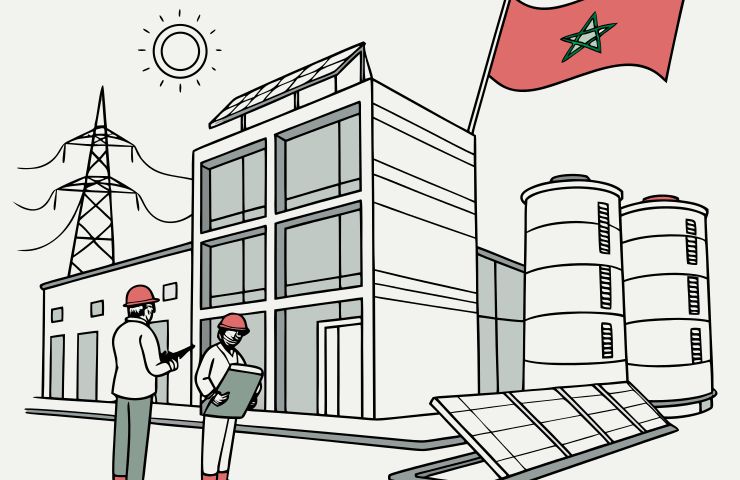
Morocco’s push for green hydrogen just took a practical turn with a new Joint Center of Excellence in Clean Hydrogen at the École Hassania des Travaux Publics campus in Casablanca. Opened this spring, the center brings together academia, industry and local ventures to pilot water electrolysis, storage and cogeneration under real-world conditions—bridging policy ambitions with hands-on research.
Developed in partnership with Jiangsu Guofu Hydrogen Energy Equipment (GUOFUHEE) and its local venture Go For Hydrogen Africa (GFHA), the center is designed as a testing ground for clean hydrogen production methods and training of engineers. While not a full-scale commercial plant, it lays the groundwork for future projects by concentrating expertise, tools and local know-how on one campus.
Hands-on Research and Technology
According to reports, the facility includes a solar-powered electrolysis array for water splitting, modular hydrogen storage vessels and a cogeneration unit that captures waste heat for auxiliary power. Though the exact capacities aren’t disclosed, this combination enables engineers to study efficiency, system integration and safety protocols under local environmental conditions.
Campus and Institutional Spotlight
Located in the heart of Casablanca, the École Hassania des Travaux Publics (EHTP) has a longstanding reputation as Morocco’s leading public engineering school. For decades it has delivered graduates in civil, mechanical and energy engineering to the national industrial sector. By hosting the clean hydrogen center on its campus, EHTP invites students and faculty to work side-by-side on pilot-scale electrolysis setups, high-pressure safety labs and integration trials. The move builds on existing renewable energy courses and positions the institution as a regional hub for hydrogen research and technical training.
Industrial Partner Profile
Jiangsu Guofu Hydrogen Energy Equipment Co. has built a portfolio spanning electrolyzers, storage tanks and refueling stations since its founding in 2016. Active across China and with recent exports to Europe, the firm underscores the center’s industrial muscle. GUOFUHEE supplied hardware under a separate 20 MW electrolyzer agreement in Morocco, demonstrating an existing commercial pipeline. Its integrated solutions—from production to transportation—offer EHTP students exposure to full value-chain design and operation.
Local Development Partner
A local venture called Go For Hydrogen Africa (GFHA) serves as GUOFUHEE’s operating partner in Morocco. While its precise corporate structure isn’t fully disclosed, GFHA is credited with bridging imported equipment and local deployment—handling site integration, logistics and stakeholder engagement. That local presence is critical: it adapts Chinese-made systems to Moroccan regulatory standards, ensures maintenance routines match climate conditions, and helps translate academic research into marketable applications.
Convening the Ecosystem
The launch coincided with the 8th Global Ecosystems Leadership Days, organized by the CleanTech Business Club. This international convening attracted investors, policymakers and tech innovators, highlighting Morocco’s role as a clean hydrogen testbed. CBC’s involvement underscores the need for cross-sector collaboration—an ecosystem where ideas meet funding and policy meets deployment—to accelerate the path from pilot setups to commercial scale.
Technical Deep Dives
- Water electrolysis: Renewable electricity splits water into hydrogen and oxygen via electrolyzers. In a solar-coupled configuration, excess PV output is diverted to hydrogen production, offering near-zero carbon intensity.
- Hydrogen storage: Compressed gas vessels and modular tanks are tested under varying pressures and material configurations to optimize cost, safety and lifetime performance for industrial applications.
- Cogeneration: A heat-recovery unit captures thermal energy from electrolysis or fuel cells to power auxiliary systems or heating loads, boosting overall plant efficiency and demonstrating integrated energy management.
Policy Meets Practice
Morocco’s hydrogen ambitions trace back to a 2019 National Hydrogen Commission and a 2021 roadmap outlining capacity goals and governance structures. The 2024 “Morocco Offer” investment package then bundled land access, fiscal incentives and streamlined permitting to attract developers. Yet without skilled labor or local proof points, those measures carried risk—making this center vital for equipping students with system-level expertise and generating data on membrane longevity, power quality and safety.
Challenges and the Road Ahead
Green hydrogen still faces cost premiums over grey hydrogen and fossil fuels, while water demand for electrolysis can strain resources unless recycling or desalination is added. Grid integration must handle variable renewable inputs, and safety regulations need constant refinement. A campus-based research hub prepares engineers for these hurdles, enabling data-driven policy and smoother project roll-out.
Looking Ahead
The center’s true impact will hinge on follow-on demonstrations, published research and a pipeline of commercial projects. If it remains a showcase, its value may prove symbolic. But if graduates and data feed into pilot plants, export studies or industrial applications, this Casablanca hub could become a cornerstone for North Africa’s clean hydrogen economy.