Green Hydrogen Production Fuels Morocco’s Decarbonized Molecules Strategy
As Europe scrambles for secure hydrogen production, Morocco is positioning itself to supply green hydrogen, green ammonia and e-methanol to global markets. In April, a joint declaration signed by Nasser Bourita, Morocco’s Minister of Foreign Affairs, and Germany’s Foreign Minister Johann David Wadephul underlined a shared commitment to integrated value chains, renewables, hydrogen and digitization. A day earlier, the national green hydrogen cluster convened industry leaders in Fes to explore high-value decarbonized molecules. This coordination signals a decisive shift in Morocco’s energy diplomacy, linking cutting-edge projects with Europe’s drive to diversify clean energy imports and modernize industrial supply chains.
Harnessing Solar Abundance for Decarbonized Molecules
Morocco’s National Energy Strategy, launched in 2009, built a foundation that delivered nearly 37 percent renewables by 2020 and now targets 52 percent by the decade’s end. Vast solar irradiance—among the world’s highest—and robust wind corridors in the Southern provinces around Laâyoune and Dakhla provide fertile ground for hydrogen production. Plans for port upgrades at Nador West Med and logistical hubs in Safi reinforce export corridors. With a population near 38.7 million and GDP per capita around $3,600, the kingdom balances growing domestic demand with ambitions to become a net exporter of zero-emission molecules.
From Electrolyzers to Ammonia Plants: Technical Foundations
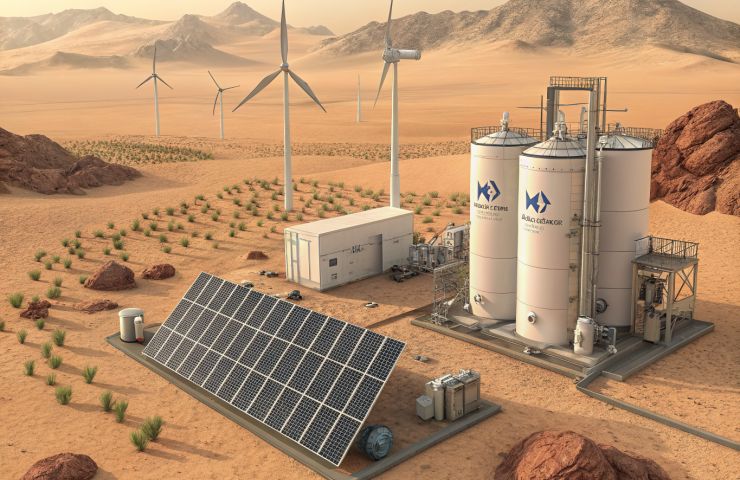
Green hydrogen is generated through electrolysis, where renewable electricity powers stacks of cells that split water into hydrogen and oxygen. Large-scale projects such as ORNX aim for roughly 2 GW of solar and wind capacity feeding electrolyzers that typically require about 50 kWh of power to produce each kilogram of H₂. The resulting hydrogen can be compressed, stored in salt caverns or tanks, or piped directly into synthesis units. In the Haber–Bosch process, green hydrogen combines with nitrogen—separated from air—to produce green ammonia under 200–300 bar and 400–500 °C over specialized catalysts. Emerging flexible Haber–Bosch units, often developed by European research centers, can ramp pressure inputs in real time to match renewable output swings. Meanwhile, e-methanol synthesis reacts captured CO₂ from direct-air capture or industrial flue gases with green hydrogen over catalytic beds, creating a low-carbon liquid fuel suitable for shipping and chemical feedstocks.
Major Projects Driving Scale
The state-owned OCP Group is pioneering the HydroJeel platform at Jorf Lasfar, backed by €30 million from the German PtX Development Fund. By next year, HydroJeel targets 100,000 tpa of green ammonia, displacing millions of tonnes of grey ammonia imports and reinvigorating Morocco’s fertilizer industry. In parallel, the ORNX consortium—comprising US-based Ortus, Spain’s Acciona and Germany’s Nordex—secured land in Laâyoune for a $4.5 billion green ammonia complex. Phase 1 foresees 100,000 tpa of green hydrogen feeding into 560,000 tpa of ammonia production, powered by some 2 GW of renewables, with expansions planned for Boujdour and Dakhla that could scale output beyond the initial phase.
Research Alliances and Funding
Beyond project development, Morocco has pursued technology partnerships. In 2025, the OCP Group signed a memorandum of understanding with Germany’s Fraunhofer institutes to co-develop catalysts and digital twin platforms for ammonia synthesis. These collaborations aim to embed advanced process control that ramps production in response to renewable output variations, reducing grid stress and optimizing energy consumption. Similar dialogues are underway to localize electrolyzer assembly and membrane fabrication, narrowing Morocco’s reliance on imported equipment.
Financing for these ventures is coming from a blend of multilateral funds, export credit agencies and private investors. The German PtX Development Fund’s €30 million commitment to HydroJeel exemplifies direct support, while the World Bank and African Development Bank have flagged interest in trans-Maghreb hydrogen corridors. Securing offtake agreements with European utilities and shipping firms remains a linchpin for bankable project financing. Morocco’s ‘Offre Maroc’ tender framework has drawn bids for electrolysis and compression units from Germany, the US and Spain.
The Moroccan government has streamlined its regulatory apparatus through a single-window licensing system, cutting renewable and hydrogen project approvals to under six months. Incentives include corporate tax breaks, carbon credit sharing schemes and state-backed guarantees for desalination infrastructure. A national roadmap publishes milestones for grid interconnection, port expansions and workforce training up to 2028, ensuring coordinated growth across regions.
Competitive Positioning and Cost Dynamics
Morocco’s levelized cost of electricity at top solar and wind sites is estimated below $20 per MWh, supporting hydrogen production costs in the $1.5–2.0 per kilogram range. While Gulf producers may still outprice this at scale, Morocco’s shorter shipping distances to Europe and integration of value chains—from generation to ammonia shipping—promise tighter margins. The ability to mix ammonia and e-methanol offtake diversifies revenues and hedges against commodity price swings.
Geopolitics and Market Dynamics
Europe’s import requirements—estimated between 45 and 90 TWh of hydrogen by 2030—underscore the urgency of securing low-emission sources outside Russia and China. Morocco’s stability, favorable investment framework and existing partnerships under the EU’s Global Gateway make it a strategic supplier. Germany’s recent hydrogen import rollouts and the US’s friend-shoring push further de-risk projects from geopolitical disruptions. Through the Morocco-Germany multidimensional strategic dialogue, both governments agreed to align industrial roadmaps, explore digital monitoring of value chains and facilitate mutual investments in renewable infrastructure.
Coordinating the National Ecosystem
The Ministry of Industry accredited Cluster Green H2 in 2023 as the coordinating body for public and private stakeholders until 2028. Its recent E-Ammonia & E-Methanol conference in Fes brought together policymakers, technology providers and financiers to tackle offtake agreements, regulatory harmonization and workforce development. The cluster’s roadmap outlines milestones for project approvals, grid interconnections and training programs to build local expertise in electrolysis, process engineering and hydrogen storage.
Balancing Growth and Constraints
Despite strong momentum, Morocco must navigate resource constraints and socio-political sensitivities. Desalination plants will be needed to supply the 9–18 litres of water required per kilogram of hydrogen, adding to energy consumption and operational costs. Projects in Western Sahara’s provinces of Laâyoune and Boujdour also raise questions about territorial status that investors and regulators must address. Moreover, scaling local manufacturing of electrolyzers, compression equipment and ammonia synthesis modules depends on technology transfer deals with European and North American partners.
As solar PV costs have plunged about 90 percent since 2010, Morocco stands at a crossroads in hydrogen energy news. With HydroJeel ramping up and ORNX advancing toward final investment decisions, the kingdom is poised to write the next chapter in industrial decarbonization. Success will hinge on securing financing, tightening policy frameworks and integrating smart monitoring systems that ensure consistent, competitive supply. The world will be watching as Morocco seeks to transform its sun-soaked deserts into a hub for clean molecules that propel the global energy transition.